
Introduction

Life insurance is meant to protect your family. But if you own the policy yourself, the death benefit becomes part of your estate, and that can create a tax problem.
While life insurance proceeds are generally income-tax-free, they can still be subject to estate tax if the policy is included in your estate. For high-net-worth families, that matters. Federal estate tax rates can reach 40%, and a large policy can push an already taxable estate even higher. A hypothetical $5 million policy, for example, could significantly increase the tax bill your heirs face, depending on your estate size and current exemption amounts.
An irrevocable life insurance trust (ILIT) is one way to address this. By moving ownership of the policy out of your name, you can keep that benefit outside your taxable estate, if the trust is set up and administered correctly. It’s a common approach in life insurance estate planning, especially if you want to pass on assets without forcing rushed decisions about selling property or other investments, depending on your estate’s liquidity.
What Is an Irrevocable Life Insurance Trust (ILIT)?
If you’re asking, “What is an irrevocable life insurance trust?”, the simplest answer is this: it’s a trust that owns your life insurance policy instead of you.
That ownership change is what makes the difference. When you own a policy personally, the death benefit is included in your estate, depending on your situation and how the policy is owned. When an ILIT owns it, the proceeds are often kept outside your estate and may not be subject to estate taxes, depending on how the trust is set up and administered.
“Irrevocable” is the keyword here. Once the trust is set up:
- You generally can’t change the beneficiaries, depending on the trust terms.
- You can’t take the policy back.
- You give up direct control over the asset.
The trust has a trustee, who manages the policy and handles administrative tasks. The beneficiaries receive the proceeds according to the terms you set when the trust is created. For example, a trustee might distribute funds over time to their children rather than in one lump sum.
This is different from a revocable living trust. A revocable trust can help with probate and organization, but it does not remove assets from your taxable estate.
How Does an ILIT Work? (Step-by-Step)
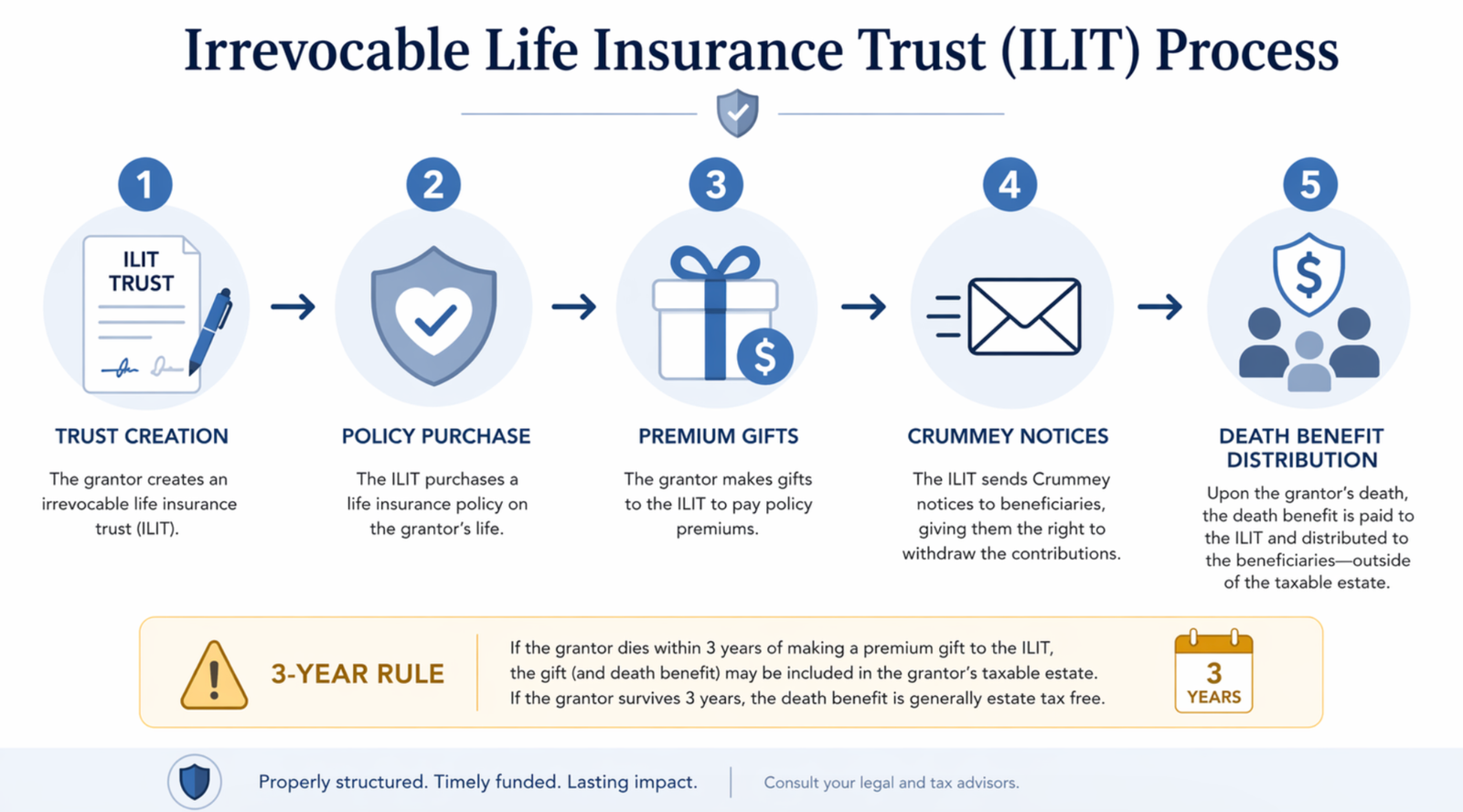
An ILIT (irrevocable life insurance trust) setup follows a specific process. Here’s how it typically works:
- You create the trust and name a trustee The trust is drafted by an estate attorney. You appoint a trustee; this cannot be you.
- The trust purchases a life insurance policy In most cases, the trust applies for and owns a new policy. You can transfer an existing policy, but that introduces additional tax considerations, including the 3-year rule if you transfer an existing policy and die within 3 years.
- You fund the premiums through annual gifts You make contributions to the trust so it can pay the premiums. These are structured as gifts.
- Crummey notices are issued to beneficiaries Each time you fund the trust, beneficiaries receive a notice giving them a temporary right to withdraw the gift. This allows the contribution to qualify for the annual gift tax exclusion (hypothetically around $19,000 per beneficiary, based on 2026 limits).
- At death, the proceeds are paid to the trust The insurance company pays the benefit to the trust, and the trustee distributes it according to your instructions.
This structure allows the policy to support life insurance for estate planning without increasing your estate size, depending on how the trust is set up and administered.
The 3-Year Rule (Important Detail) If you transfer an existing policy into an ILIT and pass away within three years, the IRS may pull the death benefit back into your taxable estate.
That’s why many people choose to have the trust purchase a new policy from the start. It can avoid the 3-year timing issue and keep the ownership structure simpler.
For example, in a hypothetical scenario, if you move a $3 million policy into a trust and pass away two years later, that $3 million could still be subject to estate taxes, depending on your estate and how the transfer is treated. With rates up to 40%, that can be a meaningful difference, depending on your situation.
Why High Net Worth Individuals Use ILITs
For families with larger estates, the numbers add up quickly. Estates above the federal estate tax exemption may face federal estate tax, depending on current law and your situation. For some families, that can create a liquidity issue for heirs.
An ILIT can help address that risk in a practical way when it’s set up and administered correctly.
- It provides liquidity Estate taxes are typically due within a set timeframe. If most of your wealth is tied up in real estate or a business, your heirs may need to sell assets quickly. An ILIT can provide cash to cover estate taxes and other settlement costs, depending on the policy and trust structure.
- It helps preserve key assets Instead of selling a family business or property under pressure, your heirs can use the insurance proceeds to meet obligations, depending on how the trust directs distributions. This is one of the main reasons ILITs are used in estate planning: to reduce the chance of a forced sale of illiquid assets.
- It supports fair distribution among heirs If one child inherits a business and another does not, an ILIT can help balance that by providing equal value through life insurance, depending on the trust terms. The trust can also control how and when beneficiaries receive funds (for example, staged distributions instead of a lump sum), based on the instructions you set in the trust.
Depending on state law and how the trust is structured, an ILIT may also provide creditor protection for trust assets. This is a legal question to review with your estate attorney.
ILIT vs. Owning the Policy Yourself Deciding whether to use an ILIT (irrevocable life insurance trust) comes down to a tradeoff: control versus tax efficiency, depending on your estate size and goals.
Owning the policy yourself:
- Full control over the policy.
- Ability to change beneficiaries.
- Simpler setup.
- Death benefit is included in your estate, depending on ownership and your situation.
Using an irrevocable life insurance trust:
- Can keep the policy’s death benefit outside your estate, if the trust is set up and administered correctly.
- May reduce estate tax exposure on the benefit, depending on current law and your situation.
- Requires giving up direct control.
- Involves ongoing administration.
For example, a hypothetical $3 million policy owned personally could increase your estate and create a significant tax liability, depending on your estate size and current law. The same policy owned by an ILIT trust would generally pass outside your estate if the trust is set up and administered correctly.
The tradeoff is that you can’t easily make changes once the trust is in place. You also need to account for administrative steps like trustee oversight and Crummey notices.
Who Should Consider an ILIT?
An irrevocable life insurance trust (ILIT) isn’t necessary for everyone. But it can make sense in specific situations (depending on your estate size, liquidity, and goals).
You may want to consider one if:
- Your estate is likely to exceed the federal exemption threshold.
- You own a business and want to plan for succession or liquidity.
- A large portion of your wealth is tied up in real estate or other illiquid assets.
- You already have a sizable life insurance policy that could increase your estate.
For example, someone with a larger estate that includes investment property or a closely held business may benefit from an ILIT structure (depending on current law and how the policy is owned).
On the other hand, if your estate is well below the exemption threshold, the added complexity may not be necessary. The decision should match your overall life insurance estate planning goals, and it can help to coordinate it with your estate attorney.
Working With an Advisor to Set Up an ILIT

Setting up an ILIT involves more than just creating a trust. It requires coordination across your estate planning team.
Typically, that includes:
- An estate attorney to draft the trust
- An insurance advisor to structure the policy
- A CPA or financial planner to align the gifting strategy
The trustee also plays an ongoing role. They manage the policy, send Crummey notices, and handle distributions.
From an insurance standpoint, many ILITs use permanent policies (such as whole or universal life) because they’re designed for long-term coverage, and premium funding is typically planned over time.
At Liberty One, we focus on the insurance side of that equation, helping you choose a policy that supports the trust’s purpose, structure it properly within the trust, and align it with your broader plan. It’s not just about setting it up. It’s also about keeping the policy and funding approach aligned with the trust terms over time.
Frequently Asked Questions
An irrevocable life insurance trust (ILIT) is a trust that owns your life insurance policy instead of you. Because the trust owns the policy, the death benefit may be kept outside your taxable estate, depending on how the trust is set up and administered. Once it’s set up, you typically can’t change the terms or take the policy back.
It comes down to ownership. When an ILIT owns the policy, the proceeds are generally kept outside your taxable estate if the trust is set up and administered correctly, which can reduce life insurance estate tax exposure. That can matter for larger estates because federal estate tax rates can reach up to 40%, depending on current law and your situation.
If you transfer an existing policy into an ILIT and pass away within three years, the IRS may include that policy back in your estate, depending on your situation and how the transfer was handled. This is why many ILITs are set up with new policies from the beginning, to avoid that timing risk.
ILITs are typically used by individuals with larger estates, business owners, or families with illiquid assets like real estate, especially when life insurance would otherwise be included in the taxable estate. If your estate could exceed the federal exemption threshold, it may be worth evaluating.
A Crummey notice (or Crummey letter) is a formal notification sent by the trustee to beneficiaries of an irrevocable trust, often an irrevocable life insurance trust (ILIT), informing them they have a limited time to withdraw a recent gift (contribution).
It matters for an ILIT because it treats the contribution as a “present interest” gift, which can help it qualify for the IRS annual gift tax exclusion (hypothetically $19,000 per beneficiary for 2026), if the trust is set up correctly and the notice requirements are followed. This is one way you can fund premiums through the trust with less gift-tax impact, depending on your situation and how the gifts are structured.
Is an ILIT Right for You?
An irrevocable life insurance trust can be a practical way to reduce estate taxes and create liquidity, especially if your estate includes large or illiquid assets, and the life insurance would otherwise be included in your taxable estate. But it’s not a simple or reversible decision, because an ILIT is irrevocable and involves ongoing administration.
Planning ahead can help your family reduce unnecessary taxes or reduce the need to sell assets under pressure, depending on your estate’s liquidity and current law. If you’re exploring life insurance estate planning, we’re here to walk through your options and help you decide what fits your situation.
Disclosure: Liberty One Wealth Advisors (“LOWA”) is registered with the Securities and Exchange Commission as an investment adviser. This content is for educational purposes only and does not constitute legal or tax advice. The effectiveness of an ILIT is subject to proper legal drafting and ongoing administrative compliance. Estate tax laws are subject to change. Always consult with a qualified estate attorney and tax professional before establishing a trust.