Introduction

Consider a hypothetical scenario: A surgeon injures their hand and can no longer perform surgery. They still have years of training and experience, so they take a consulting role, earning $80,000 per year instead of $400,000 per year.
Here’s where the definition matters. Under some policies, they may not qualify for benefits because they’re still able to work, depending on the policy’s definition of disability and how it is applied. Under own-occupation disability insurance, they may qualify, depending on the policy’s definition of “own occupation” and the contract terms, because they can’t perform the specific job they were trained to do.
This is the distinction many people overlook. Disability insurance isn’t just about whether you can work at all. It’s about whether you can maintain your income at the level your career was built on, depending on your coverage and definition of disability. To understand why, it helps to start with the definition.
What Is Own-Occupation Disability Insurance?
Own-occupation disability insurance means you’re considered disabled if you can’t perform the material duties of your specific occupation, even if you’re able to work in another role. Policy definitions and contract terms vary.
In simple terms:
- If you can’t do your job, you may be able to receive benefits, depending on the policy’s definition of disability.
- It may still apply even if you’re earning income somewhere else, depending on the contract terms.
This is different from an any-occupation policy. With that structure, you only qualify if you’re unable to work in any job that fits your education or experience, depending on the policy’s definition. That’s a much higher bar.
Hypothetical Example:
- Own-occupation: A surgeon who can’t operate may qualify, depending on the policy’s definition of “own occupation”.
- Any-occupation: That same surgeon may not qualify if they can teach or consult, depending on the policy’s definition and how it is applied.
This is why own-occupation disability insurance is often preferred by professionals with specialized careers, depending on their goals and the policy options available. It focuses on protecting the work you’ve trained for, not just your ability to earn in general.
Why the Distinction Matters for High Earners
As your income increases, the definition can matter more, because the gap between your current role and “other work you could do” can be large.
A physician earning $400,000 who transitions into a consulting role earning $80,000 is still working, but they’ve lost 80% of their income. Under an any-occupation policy, they may receive no benefits, depending on the policy’s definition of disability and how it is applied.
The same applies in other fields:
- An attorney who can’t practice law but can teach, depending on the policy’s definition and the duties the insurer considers “work”.
- An executive who can no longer perform high-level leadership duties, depending on the policy’s definition and the duties of their occupation.
In each case, the person is still employable, but not at the same earning level, depending on the role and market. This is the core issue with own-occupation vs. any-occupation disability. The higher your income, the fewer comparable alternatives may exist. Your skills are often specialized, and your earning power is tied to a specific role. If the definition doesn’t match what you actually do day to day, a partial career loss can become a long-term financial setback, depending on your income needs and coverage terms.
Key Features to Look for in Own-Occupation Policies
Not all own-occupation disability insurance policies are structured the same way. The details affect how your coverage works if you need to file a claim.
Start with how your occupation is defined. In many own-occupation policies, benefits may be paid if you can’t perform the “substantial and material duties” of your specific specialty, even if you can still work in another capacity, depending on the contract terms. This is why specialty-specific wording matters. There’s a meaningful difference between “physician” and “orthopedic surgeon.”
Next is the benefit period. The benefit period is how long benefits can be paid if you remain disabled under the policy’s definition. Many long-term policies are designed to pay up to a set age (often age 67), but the benefit period varies by contract.
The elimination period is the waiting period before benefits begin. A 90-day elimination period is common, but the length and how it’s measured vary by policy. If you choose a longer elimination period, you’ll typically need savings to cover that gap.
The benefit amount matters, too. Some policies are designed to replace about 60%–80% of your pre-tax income, depending on the contract terms, offsets, and how benefits are calculated.
Also, look for partial or residual disability benefits. Some policies provide partial or “residual” benefits, meaning benefits that may pay if you can still work but with reduced capacity or reduced income, depending on how the policy defines and measures the loss.
Riders That Matter for High-Income Professionals
Once the core structure is in place, riders help fine-tune your coverage.
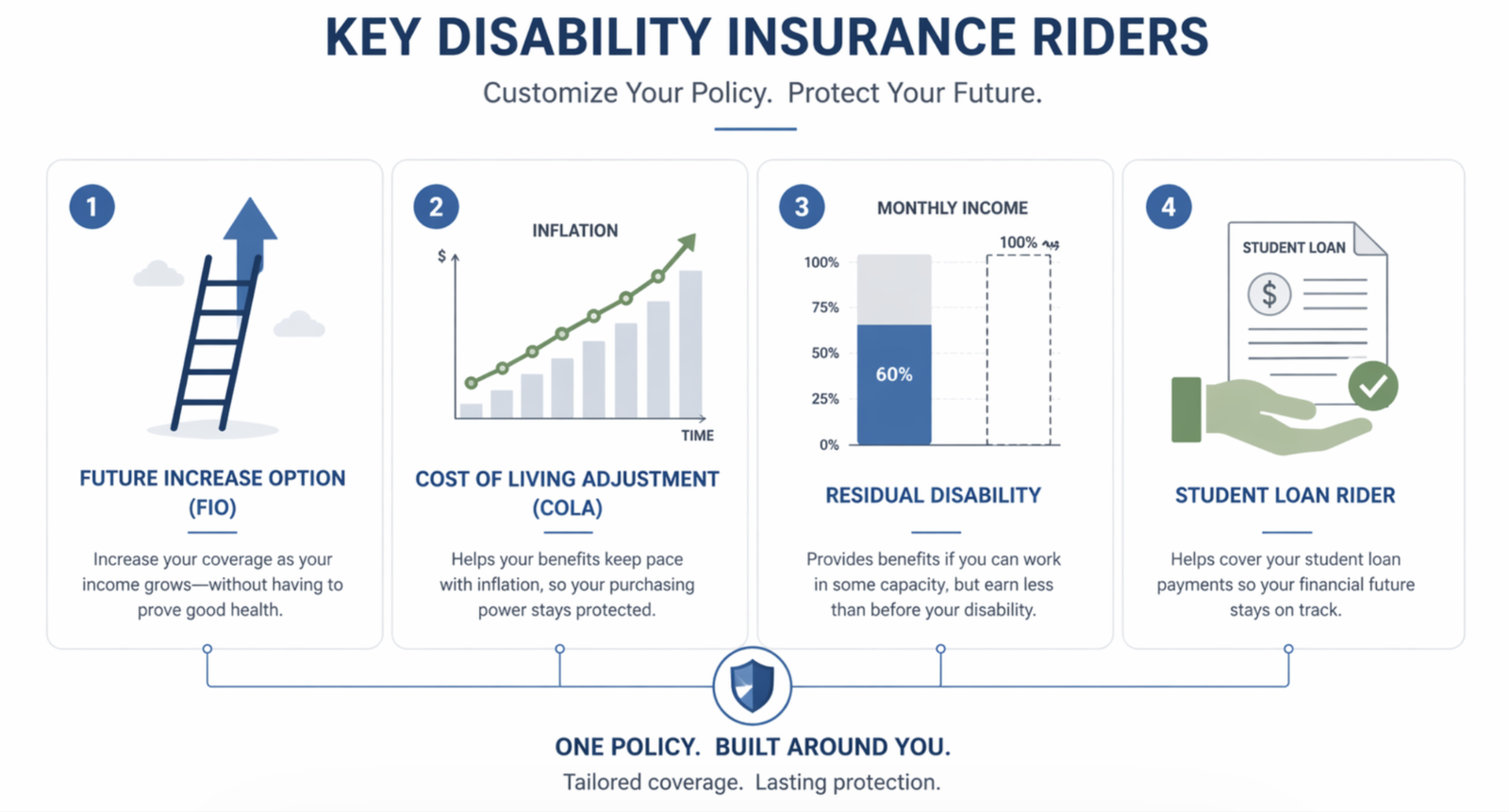
- Future Increase Option (FIO): Allows you to increase your coverage as your income grows, without going through medical underwriting again, depending on the rider and the policy terms. This is especially useful early in your career.
- Cost of Living Adjustment (COLA): Increases your benefit over time if you’re on a long-term claim, depending on the rider terms. It helps maintain purchasing power over the years.
- Residual or Partial Disability Coverage: If you can still work but your income drops, such as by reducing hours, you can receive partial benefits, depending on how the policy defines and measures a partial loss.
- Non-cancelable and Guaranteed Renewable: These terms typically mean the insurer can’t cancel your coverage or change your premiums as long as you pay on time, depending on the contract terms.
- Student Loan Rider: For those with debt, this can help cover payments during a disability, depending on the rider’s terms.
- Transitional Own-Occupation Provision: This type of feature can help address the income gap if you return to work in a different role after a disability, depending on the contract terms.
These options make disability insurance for professionals more adaptable to how careers and income actually change over time, depending on what your policy offers.
Group Disability vs. Individual Own-Occupation Coverage

Many professionals have disability coverage through their employer. It’s a helpful starting point, but it can have limitations, depending on the plan’s terms.
Group plans commonly:
- Switch to an any-occupation definition after a set period (often around 24 months), depending on the plan.
- Treat benefits as taxable in some cases, depending on how premiums are paid.
- End when you leave the employer, unless the plan is portable, depending on plan rules.
This can create gaps, especially if your income is high or your role is specialized. Individual own-occupation disability insurance can give you more control, depending on the policy options available. You can often choose the definition, the benefit amount, and the structure. The policy may stay with you if you change jobs or become self-employed. If you pay the premiums yourself with after-tax dollars, benefits are often tax-free, depending on tax rules.
How Much Disability Coverage Do High Earners Need?
 A common starting point is replacing around up to 60-80% of your gross earnings, depending on the policy and underwriting. If you pay premiums with after-tax dollars, benefits may be tax-free. In those cases, this can align closely with your take-home pay.
However, most carriers may cap coverage, so the benefit amount may be limited relative to your earnings. That’s where higher-limit disability coverage comes in. You may need to layer multiple policies or use specialized programs. Hypothetical Example: Someone earning $500,000 may need to combine policies to reach their intended coverage level, depending on carrier limits and underwriting.
If you own a business, consider Business Overhead Expense (BOE) coverage. BOE coverage is separate from personal disability insurance and helps cover fixed costs like rent, payroll, and utilities if you’re unable to work, depending on the policy terms.
Putting It All Together: What This Means for You
If you’re employed, review your group coverage carefully. Look at how long the disability definition lasts and where gaps may exist. If you’re self-employed or a business owner, individual coverage can be a key part of the plan. Adding BOE coverage can help support your business expenses during a claim.
If you’re early in your career, focus on securing coverage while you’re healthy, since eligibility and pricing can depend on underwriting. Options like a Future Increase Option (FIO) can allow your policy to grow with your income.
Protecting Your Most Valuable Asset
Your ability to earn an income supports everything else in your financial life. Own-occupation disability insurance can help protect your income, even if you shift into a different role, depending on the policy’s definition and terms.
At Liberty One, we work with professionals, families, and business owners to review coverage, explain your options clearly, and build an approach that reflects how you actually earn. If you’d like a second look at your current coverage, we can walk through it with you in plain language so you understand what it does, what it doesn’t, and what questions to ask next.
Frequently Asked Questions
Own-occupation disability insurance can pay benefits if you can’t perform the main duties of your specific job, depending on the policy’s definition of disability and contract terms, even if you can still work in another role. For example, a surgeon who can no longer operate but earns income consulting may still qualify, depending on how the policy defines “own occupation.” It’s designed to help address income loss tied to your specific role, depending on benefit limits and how the policy is structured.
Own-occupation coverage may pay benefits if you can’t do your specific job, depending on the policy’s definition of disability and contract terms. Any-occupation coverage may pay benefits only if you can’t work in any job that fits your education or experience, depending on the policy’s definition of disability and contract terms. Many group plans may switch to any-occupation after a set period, often around 24 months, depending on the plan, which can make qualifying for benefits more difficult.
It’s especially important for high-income professionals, specialists, and business owners whose earnings depend on specific skills, especially if your policy defines disability based on your specialty. If moving into another role would significantly reduce your income, this type of coverage can help address that gap, depending on the policy’s definition of disability and benefit terms. It can also be relevant for self-employed individuals without employer coverage, depending on the options available and how you’re insured.
Many people aim to replace about 60%–80% of their after-tax income as a planning reference. Because benefits may be tax-free, depending on how premiums are paid and the policy terms, they can come close to your take-home pay, depending on the benefit amount and your situation. High earners may need layered or high-limit coverage since many carriers cap benefits at around 60% of income, depending on the carrier and underwriting.
Common riders include a future increase option (FIO), which can let you increase coverage over time without new medical underwriting, depending on the rider terms; a cost of living adjustment (COLA), which can increase benefits over time during a long-term claim, depending on the rider; and residual disability coverage, which can pay partial benefits if you can work but your income drops, depending on how the policy measures loss. A student loan rider may also be useful if you have ongoing debt obligations, depending on the rider terms and eligibility.
Conclusion: A More Reliable Way to Answer the Question
There’s no single formula that answers how much coverage you need. Taking the time to calculate your coverage based on your specific obligations and goals helps ensure your income is addressed.
At Liberty One, we review your income, debts, assets, and goals with you so you can make an informed decision. If you want help thinking through your numbers or reviewing your current coverage, we’re here to have that conversation when you’re ready.
Disclosure: Liberty One Wealth Advisors (“LOWA”) is registered with the Securities and Exchange Commission as an investment adviser. This content is for educational purposes only and does not constitute a recommendation for any specific insurance product. Disability insurance policies involve exclusions, limitations, and terms for keeping them in force. All examples are hypothetical and for illustrative purposes only. Please consult with a qualified insurance professional and tax advisor regarding your specific circumstances.