
Introduction
Teachers, nurses, government employees, and nonprofit workers often have access to retirement plans that many private-sector employees do not. If you are comparing a 457 vs 403b plan, both accounts offer tax-advantaged retirement savings, but they operate differently in ways that can directly affect retirement planning decisions.
The difference between 457 and 403b plans becomes especially important when evaluating early withdrawal rules, catch-up contributions, employer matches, and retirement flexibility. For public sector employees and nonprofit workers, understanding how each plan works can help support more informed contribution decisions and a stronger long-term retirement strategy.
What Is a 403(b) Plan?
A 403(b) is an employer-sponsored retirement plan available primarily to employees of public schools, nonprofit organizations, and certain healthcare systems. Teachers, university employees, hospital workers, and nonprofit professionals commonly use these accounts as part of their workplace benefits.
Like a traditional 401(k), a 403(b) allows employees to make pre-tax payroll contributions that grow tax-deferred over time. Withdrawals are generally taxed as ordinary income during retirement.
At the time of writing, IRS guidance for 403(b) contribution limits for 2026 had not been finalized. Historically, annual contribution limits for 403(b) plans have generally aligned with other employer-sponsored retirement plans, with additional catch-up contributions available for eligible employees age 50 and older.
Some employers also offer matching contributions, although match formulas vary by organization and plan structure.
Key features of a 403(b) plan may include:
- Pre-tax contributions and tax-deferred investment growth
- Employer matching contributions when available
- Additional catch-up contributions for eligible employees age 50 and older
- The 15-year service catch-up provision for certain long-tenured employees
- Investment options often limited to mutual funds and annuities
When reviewing 403b and 457 contribution limits, it is important to understand whether your employer offers one plan or both.
Another important consideration is withdrawal timing. In most cases, withdrawals before age 59½ may be subject to a 10% IRS penalty in addition to ordinary income taxes unless an exception applies.
This early withdrawal rule is one of the most significant differences between 457 and 403b plans, particularly for teachers, healthcare workers, firefighters, and other public sector employees considering retirement before age 59½.
What Is a 457(b) Plan?
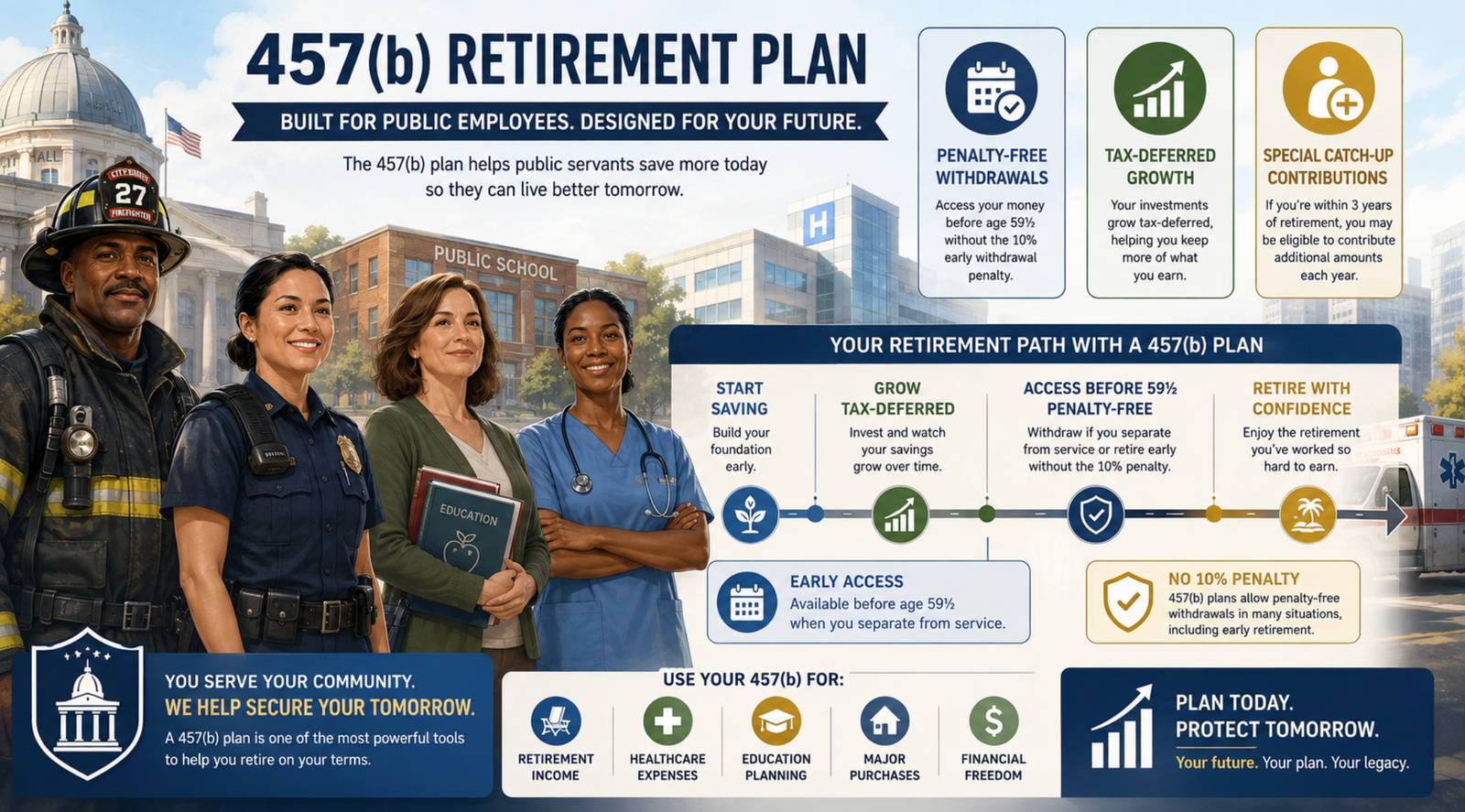
A 457(b) plan is a tax-advantaged retirement account commonly offered to state and local government employees, including teachers, firefighters, police officers, municipal workers, and public university employees. Some nonprofit organizations also offer non-governmental 457(b) plans to select executives or key employees, which may be subject to different rules and risks.
Like a 403(b), a 457(b) allows employees to make pre-tax payroll contributions that grow tax-deferred until retirement withdrawals begin. Withdrawals are generally taxed as ordinary income during retirement.
Historically, 457b contribution limits have generally mirrored 403(b) contribution limits, including age-based catch-up contributions. At the time of writing, IRS guidance for 2026 limits had not been finalized.
Many public employees have access to both plans, particularly in public healthcare systems and higher education institutions. Understanding whether you can contribute to both accounts is an important part of comparing a 457b vs 403b retirement plan.
Key features of a governmental 457(b) plan include:
- Pre-tax contributions and tax-deferred investment growth
- Contribution limits generally aligned with 403(b) plans
- Investment options that vary by employer and plan provider
- Special 457 catch-up contributions during the three years before normal retirement age
- Potentially penalty-free withdrawals after separation from service, regardless of age (for governmental plans)
One of the most important distinctions is early withdrawal flexibility. Governmental 457(b) plans generally allow participants to access funds after leaving their employer without the additional 10% IRS penalty that often applies to many 403(b) withdrawals before age 59½.
Eligible participants using the special 457 catch-up provision may be able to contribute up to double the standard annual limit during the three years before normal retirement age, depending on prior contribution history and plan rules.
This flexibility can be especially relevant for teachers, healthcare workers, firefighters, police officers, and other public sector employees planning to retire earlier than traditional retirement age.
Key Differences Between 457(b) and 403(b)

| Feature | 403(b) | 457(b) |
|---|---|---|
| Typical Employers | Public schools, nonprofits, healthcare systems | State and local governments, some nonprofits |
| Tax Treatment | Pre-tax contributions and tax-deferred growth | Pre-tax contributions and tax-deferred growth |
| Early Withdrawal Rules | 10% IRS penalty before age 59½ in many cases | No 10% penalty after separation from service (governmental plans) |
| Employer Match | Sometimes available | Sometimes available |
| Catch-Up Contributions | Age 50+ catch-up and possible 15-year rule* | Age 50+ catch-up and special 457 catch-up* |
| Investment Options | Often limited to annuities and mutual funds | Varies by employer and plan provider |
| ERISA Status | Often subject to ERISA in private nonprofit plans | Governmental plans generally exempt from ERISA |
| Creditor Protection | Typically stronger under ERISA plans | Varies by plan structure |
| Contribution Limits | Separate from 457(b) limits | Separate from 403(b) limits |
The most significant practical difference between a 457 vs 403b plan is withdrawal flexibility. Governmental 457(b) plans generally allow penalty-free withdrawals after separation from service regardless of age, while many 403(b) withdrawals before age 59½ may remain subject to a 10% IRS penalty.
This distinction may be especially relevant for public employees planning to retire before age 59½. However, employees with a strong 403(b) employer match may still benefit from contributing enough to capture the full match first.
Can You Contribute to Both a 457(b) and 403(b)?
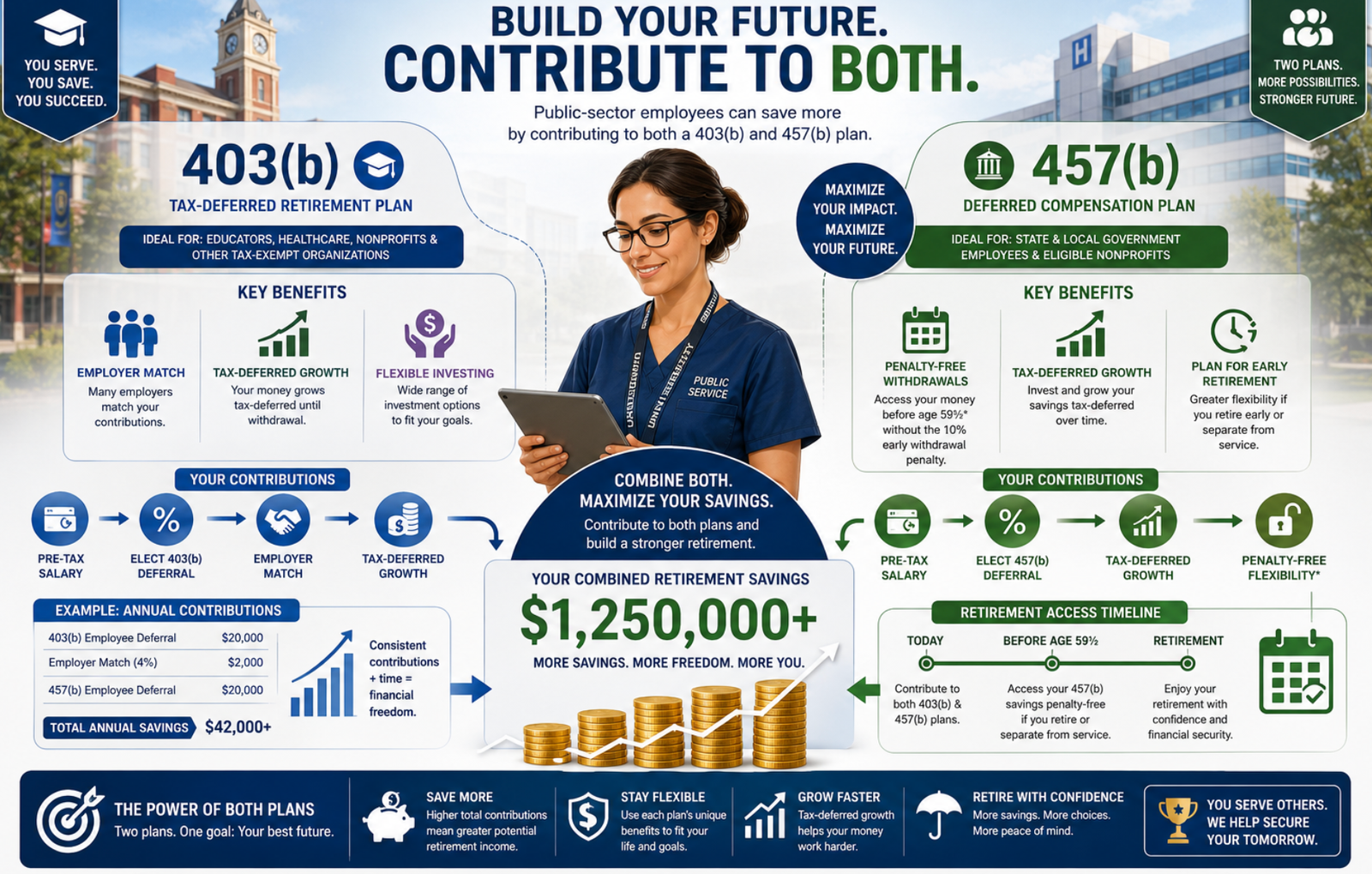
Yes — if your employer offers both plans, you can generally contribute to both accounts independently. This is one of the more flexible retirement savings opportunities available to teachers, healthcare workers, government employees, and nonprofit professionals.
Because the contribution limits are typically separate, eligible employees may be able to contribute substantially more than workers with access to only one employer-sponsored retirement plan. Depending on IRS limits, age-based catch-up rules, and special 457 catch-up provisions, combined contributions can be significantly higher than a single-plan contribution limit.
When evaluating whether you can have both a 403b and 457, contribution prioritization often depends on employer benefits and retirement timing:
- If your employer offers a 403(b) match, contributing enough to receive the full match is often the first priority
- Many employees then consider the 457(b) due to its withdrawal flexibility after separation from service
- Employees within three years of retirement may benefit from the special 457 catch-up provision
- Some public sector employees choose to maximize both accounts as part of a broader retirement strategy
For many workers comparing a 403b vs 457b retirement plan, the strongest long-term approach may involve using both plans together where feasible.
Which Plan Should You Prioritize?
The appropriate strategy depends on retirement timing, employer benefits, and overall financial goals.
A general decision framework may include:
- If you plan to retire before age 59½, prioritizing a governmental 457(b) may provide greater withdrawal flexibility
- If your employer offers a 403(b) match, contributing enough to receive the full match is often an important first step
- Employees approaching retirement may benefit from the special 457 catch-up provision, subject to plan rules
- If you have access to both plans and capacity to contribute, using both may enhance long-term savings flexibility
For many public employees comparing a 457 vs 403b strategy, the decision is not necessarily one plan or the other. Both accounts can play complementary roles within a broader retirement plan.
As retirement approaches, coordination of withdrawals, pensions, Social Security timing, and tax considerations becomes increasingly important. A fiduciary advisor can help evaluate how 403(b) and 457(b) accounts fit within a comprehensive financial plan.
To learn more about Liberty One’s approach, explore [retirement planning], [financial planning], and [what financial advisors do].
Conclusion
Both 403(b) and 457(b) plans can be valuable retirement savings tools, and having access to both may provide additional flexibility. The appropriate 457 vs 403b strategy depends on retirement timeline, employer plan features, withdrawal needs, and overall financial circumstances.
A fiduciary advisor familiar with public sector retirement plans can assist with evaluating contribution strategies, withdrawal sequencing, pensions, and broader financial planning considerations.
FAQs
What is the main difference between a 457(b) and a 403(b)?
The primary difference involves early withdrawal rules. Many 403(b) withdrawals before age 59½ may be subject to a 10% IRS penalty unless an exception applies. Governmental 457(b) plans generally allow penalty-free withdrawals after separation from service regardless of age.
Can you contribute to both a 457(b) and 403(b) at the same time?
Yes — if your employer offers both plans, you can generally contribute to each independently, subject to applicable IRS limits and plan rules.
Does the 457(b) have an early withdrawal penalty?
Governmental 457(b) plans generally do not impose a 10% early withdrawal penalty after separation from service. Withdrawals are still taxed as ordinary income. Non-governmental 457(b) plans may have different rules.
Which plan is better — 457(b) or 403(b)?
There is no universal answer. A 457(b) may offer greater flexibility for early retirement, while a 403(b) employer match may provide immediate value. The optimal approach depends on individual circumstances.
What are the contribution limits for 457(b) and 403(b) plans in 2026?
At the time of writing, the IRS had not finalized 2026 contribution limits. Historically, both plans have followed similar annual limits with additional catch-up contributions available for eligible participants.
Important Disclosure: This material is for informational purposes only and should not be construed as tax, legal, or investment advice. Plan rules, eligibility, and withdrawal provisions vary by employer and plan provider. Investors should consult with a qualified financial, tax, or legal professional regarding their individual circumstances.
*Important Disclosure: 2026 Catch-Up Contribution Rules
Under the SECURE 2.0 Act, eligibility for catch-up contributions is subject to new income-based requirements effective January 1, 2026.
Roth Requirement for High Earners: If your prior-year wages (2025) from the employer sponsoring your plan exceeded $150,000, all age-based catch-up contributions must be made on a Roth (after-tax) basis. If your employer’s plan does not offer a Roth component, you may be ineligible to make catch-up contributions for the 2026 tax year.
Limits & Availability: The standard 2026 catch-up limit is $8,000, while the “Super Catch-Up” for ages 60–63 is $11,250. These features are optional; please verify with your specific plan administrator that these provisions have been adopted by your employer’s plan.
Tax Advice: This information is for educational purposes only. Retirement plan rules are complex and subject to change. We recommend consulting with a qualified tax professional or financial advisor to determine how these limits apply to your specific financial situation.