Introduction
Buying a stock, ETF, or mutual fund is investing. Investment planning is the broader process of building a strategy around your financial goals, time horizon, tax situation, and tolerance for risk, then adjusting that strategy as circumstances change over time.
Effective investment planning connects each investment decision to a larger objective. A household saving for retirement while planning for future education expenses, for example, may require different investment approaches for each goal. Rather than reacting to short-term market movements, a structured plan provides a framework for long-term decision-making.
This guide explains what investment planning involves and how a fiduciary advisor may approach the process differently from a robo-advisor or self-directed platform.
What Is Investment Planning?
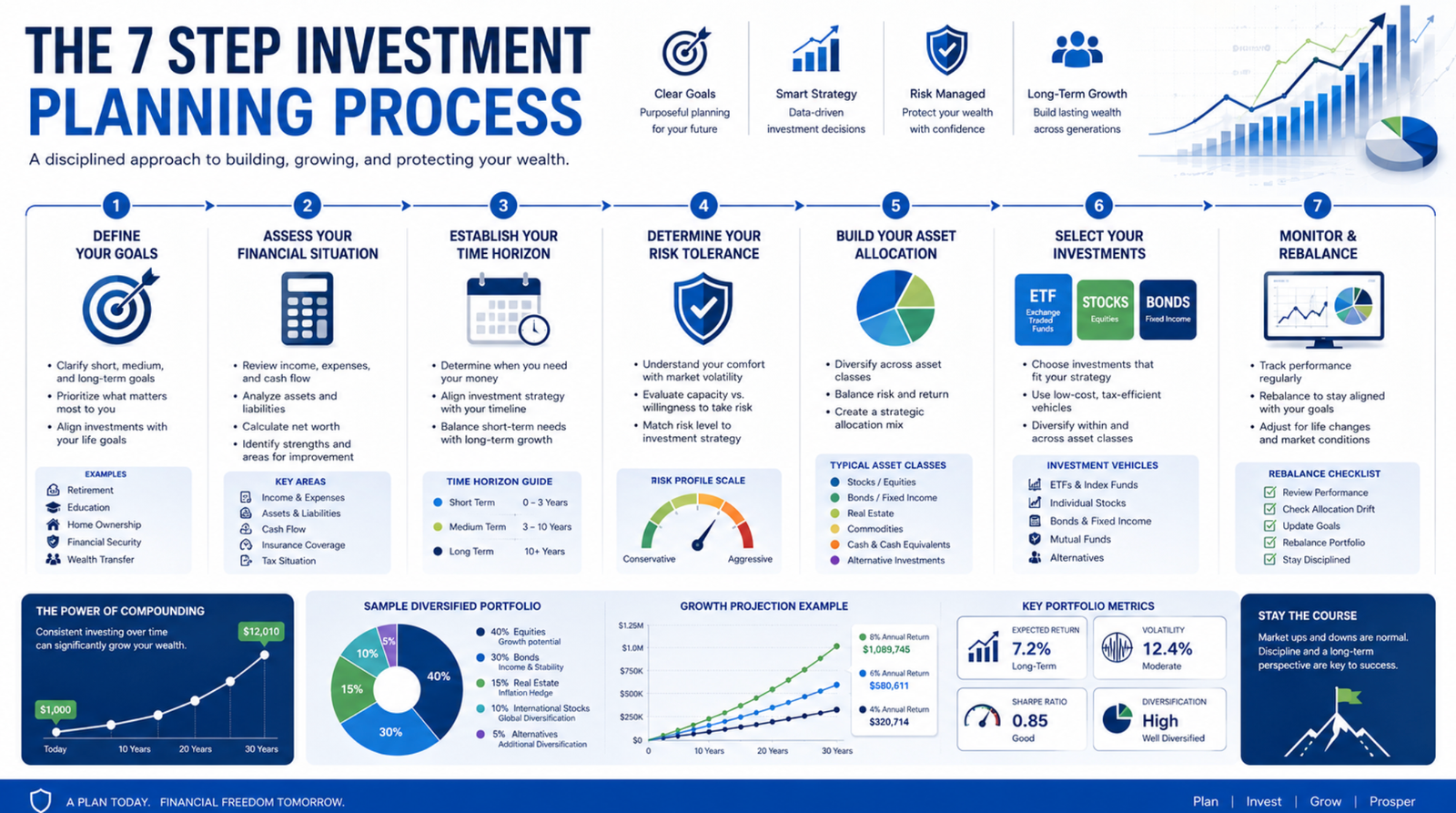
Investment planning is the process of building and maintaining a long-term strategy for managing financial assets. It generally includes setting financial goals, evaluating resources, determining an appropriate level of risk, establishing an asset allocation, selecting investments, and implementing a process for ongoing monitoring and adjustments.
A structured investment planning process typically includes:
- Defining goals such as retirement, education funding, wealth transfer, or major purchases
- Evaluating income, savings, liabilities, and existing investment accounts
- Determining an appropriate level of investment risk based on timeline and objectives
- Building an asset allocation across equities, fixed income, cash, and other asset classes
- Selecting investments that align with the broader strategy
- Monitoring and adjusting the portfolio as financial circumstances and markets change
Unlike product-based investing, investment planning focuses on how each decision supports broader financial objectives. Retirement timelines, tax considerations, liquidity needs, and family priorities can all influence portfolio construction.
A structured approach may also help reduce emotionally driven decisions during market volatility. Rather than reacting to short-term performance, investors follow a defined framework aligned with long-term goals.
Personal investment planning is intended to be strategic, individualized, and coordinated with the broader financial picture. A fiduciary advisor typically approaches investment planning by focusing on client goals and long-term outcomes rather than specific products or short-term market movements.
The Investment Planning Process Step by Step
The investment planning process is designed to create a strategy that evolves alongside financial goals and changing circumstances.
Step 1: Define Your Goals
Every investment plan begins with identifying specific financial goals, such as:
- Retirement planning
- Education funding
- Wealth transfer objectives
- Major purchases such as a home
- Emergency reserves and liquidity needs
Clear goals help determine how different assets are allocated. Longer-term goals may support greater exposure to growth-oriented investments, while shorter-term goals often require a greater focus on stability and liquidity.
Step 2: Assess Your Current Financial Situation
This step involves evaluating your overall financial position, including:
- Income and savings rates
- Existing investment accounts
- Assets and liabilities
- Employer retirement benefits
- Equity compensation, such as restricted stock units (RSUs) or stock options
For many individuals, elements such as deferred compensation or concentrated stock positions can add complexity to the planning process.
Step 3: Establish Your Time Horizon
Different goals have different timelines, which directly affect investment strategy.
Long-term investment planning may allow for increased exposure to growth-oriented assets due to a longer recovery period for market volatility. Shorter time horizons generally require more conservative allocations focused on capital preservation and liquidity.
Step 4: Determine Risk Tolerance and Risk Capacity
Investment planning considers both subjective risk tolerance and objective risk capacity.
An investor’s comfort level with volatility may differ from their financial ability to absorb losses. A well-structured plan aligns investment risk with both the emotional and financial aspects of the investor’s situation.
Step 5: Build Your Asset Allocation
Asset allocation determines how investments are distributed among various asset classes. This is a central component of investment planning because it influences both expected returns and overall portfolio risk.
Diversification across asset classes, sectors, and geographies may help reduce concentration risk.
Step 6: Select Investments
Once an allocation strategy is defined, investments are selected within each category. These may include ETFs, mutual funds, individual securities, bonds, or other vehicles, depending on the overall plan.
Investment selection is generally intended to support the broader strategy rather than drive it.
Step 7: Monitor and Rebalance
Investment planning is an ongoing process. Over time, market performance may cause allocations to drift from their targets.
Periodic rebalancing helps maintain alignment with the intended strategy, risk tolerance, and financial goals. Life events such as retirement, inheritance, divorce, or a business transaction may also require adjustments.
Key Investment Planning Considerations for Different Life Stages
Investment priorities often evolve over time, and strategies that are appropriate in one stage may not be appropriate in another.
Accumulation phase (approximately 30s–50s):
Planning often focuses on long-term growth, maximizing contributions to employer-sponsored plans and IRAs, maintaining diversified equity exposure, and managing factors such as employer stock compensation. Many households also balance retirement savings with education funding and other financial goals.
Pre-retirement (approximately 55–65):
As retirement approaches, planning may shift toward risk management and income sustainability. Sequence of returns risk becomes a greater consideration, and investors may evaluate portfolio adjustments, income projections, and potential tax strategies such as Roth conversions.
Retirement:
Investment planning typically emphasizes income generation, withdrawal sequencing, Required Minimum Distribution (RMD) planning, and inflation considerations. Coordinating withdrawals across account types may affect after-tax income outcomes.
High-net-worth investment planning:
Higher-net-worth households may face additional complexity involving tax efficiency, concentrated positions, alternative investments, and liquidity management. Planning often focuses on balancing growth, diversification, and tax considerations within a broader wealth strategy.
Investment Planning and Tax Strategy
Tax considerations are an important component of investment planning. Portfolio structure, asset location, and withdrawal strategy can all affect after-tax outcomes.
During accumulation years, planning may involve maximizing tax-advantaged contributions and managing tax exposure related to investment income or equity compensation. As retirement approaches, strategies may shift toward managing taxable income and coordinating withdrawals.
In retirement, tax-efficient withdrawal sequencing across taxable, tax-deferred, and Roth accounts can influence overall portfolio longevity. For higher-net-worth individuals, additional strategies such as tax-loss harvesting, direct indexing, and coordinated estate and investment planning may be considered.
Because tax laws and individual circumstances can change, investment planning strategies typically require ongoing review and coordination.
Common Investment Planning Mistakes

Investment decisions made without a coordinated strategy can lead to avoidable risks. Common issues include:
- Allowing asset allocation to drift: Market performance can unintentionally increase portfolio risk if allocations are not monitored and rebalanced
- Holding overly concentrated positions: Excess exposure to a single company or sector can increase volatility and risk
- Overlooking tax impact: Taxes on dividends, interest, and capital gains can reduce net returns over time
- Confusing risk tolerance with risk capacity: Emotional comfort does not always align with financial ability to absorb losses
- Failing to update the plan: Major life events can significantly affect timelines, risk profile, and planning needs
- Treating investment planning as a one-time decision: Ongoing monitoring and adjustments are typically required
When to Work With a Fiduciary Investment Advisor
Some investors are comfortable managing simpler portfolios independently. However, investment planning often becomes more complex as financial situations evolve.
Situations where professional guidance may be beneficial include:
- Approaching retirement and evaluating long-term income sustainability
- Managing proceeds from a business sale, inheritance, or other liquidity event
- Holding concentrated equity positions or complex compensation structures
- Coordinating investment strategy with tax planning and withdrawal decisions
- Uncertainty about whether current investments align with long-term objectives
A fiduciary advisor generally approaches investment planning by aligning strategies with client goals and long-term outcomes. This may include:
- Customized portfolio construction and asset allocation
- Coordination with tax planning strategies
- Ongoing monitoring and adjustments
- Behavioral guidance during market volatility
- Integration with broader financial planning
While automated platforms may assist with basic investment management, they generally do not provide the same level of personalized coordination or comprehensive planning.
Conclusion
Investment planning is a foundational component of a well-structured financial strategy. It extends beyond selecting investments and focuses on aligning portfolio decisions with goals, timelines, risk considerations, and tax implications.
For individuals navigating more complex financial circumstances or major life transitions, a coordinated approach with a fiduciary advisor may provide additional clarity and structure.
If you would like to evaluate how your current investment strategy aligns with your broader financial goals, Liberty One Wealth welcomes the opportunity to start a conversation.
Frequently Asked Questions
What is investment planning and why does it matter?
Investment planning is the process of building a long-term strategy based on financial goals, timeline, risk tolerance, and tax considerations. It helps ensure that investment decisions are aligned with broader financial objectives rather than short-term market movements.
What are the steps in the investment planning process?
Typical steps include defining goals, assessing financial position, establishing a time horizon, determining risk tolerance, building an asset allocation, selecting investments, and monitoring the strategy over time.
What is the difference between investing and investment planning?
Investing refers to purchasing assets such as stocks or funds, while investment planning focuses on how those decisions support long-term goals, risk management, and tax efficiency.
How does a fiduciary advisor approach investment planning differently?
A fiduciary advisor generally builds strategies around client goals, financial circumstances, and long-term needs, rather than focusing primarily on products or short-term performance.
When should I work with an investment planning advisor?
Investors may consider professional guidance when approaching retirement, managing complex assets, coordinating tax strategies, or evaluating whether their current plan aligns with long-term goals.
Important Disclosure: This material is for informational purposes only and should not be construed as investment, tax, or legal advice. Investment strategies involve risk, including possible loss of principal, and are not guaranteed to achieve any objective. Circumstances, tax laws, and investment outcomes vary by individual. Investors should consult with appropriate professionals regarding their specific situation.