
Introduction

If you’re a high earner, you’ve likely already contributed up to the limits in your 401(k), IRA, and Roth options. After that, most additional investments land in taxable accounts, and that’s where taxes can start to affect compounding over time. In a taxable account, taxes on interest, dividends, and realized gains can reduce what stays invested, especially when you’re investing at scale.
This is where private placement life insurance comes into the conversation. It’s a specialized strategy that combines investing with a life insurance structure, allowing for tax-deferred growth, and, in some cases, tax-advantaged access, depending on the policy design and how it is managed.
You can think of it as a form of life insurance used as a planning tool for holding investments, but with strict rules and higher minimums. It’s typically limited to accredited investors who have already built substantial wealth and are looking for additional ways to grow and transfer it, based on their goals and the policy’s terms. To understand whether it fits your situation, it helps to start with how it’s structured.
What Is Private Placement Life Insurance?
Private placement life insurance (PPLI) is a customized variable universal life policy offered through private placement (not standard retail channels), typically aimed at accredited investors or other qualified purchasers.
In practice, it’s most often discussed in ultra-high-net-worth planning, where investors may have significant investable assets (often cited in the $5M–$20M+ range). Some programs are structured around hypothetical premium commitments of $1–$2M+ (and in other cases, multi-year minimums can be higher), depending on the carrier and program.
Like other variable life structures, PPLI can act as a tax-advantaged “wrapper” around an investment portfolio under current tax rules. The policy’s cash value may have access to a broader set of investment options, including alternative strategies, compared with many retail variable universal life policies.
PPLI is also often described as having a different cost structure than retail products. Some PPLI programs are marketed with lower commissions and lower ongoing charges, with annual fees sometimes cited around 0.50% to 0.70% of assets under management, but actual costs vary by policy, manager, and underlying investments.
Tax treatment is a primary reason people evaluate PPLI: growth inside the policy is generally tax-deferred, policy loans may be structured in a tax-advantaged way, and death benefits are generally income-tax-free, subject to the contract meeting applicable tax rules and being managed properly. Because PPLI is complex, it typically requires ongoing professional management and careful compliance with IRS rules—including diversification and investor control—to maintain intended tax treatment.
How PPLI Works in Practice
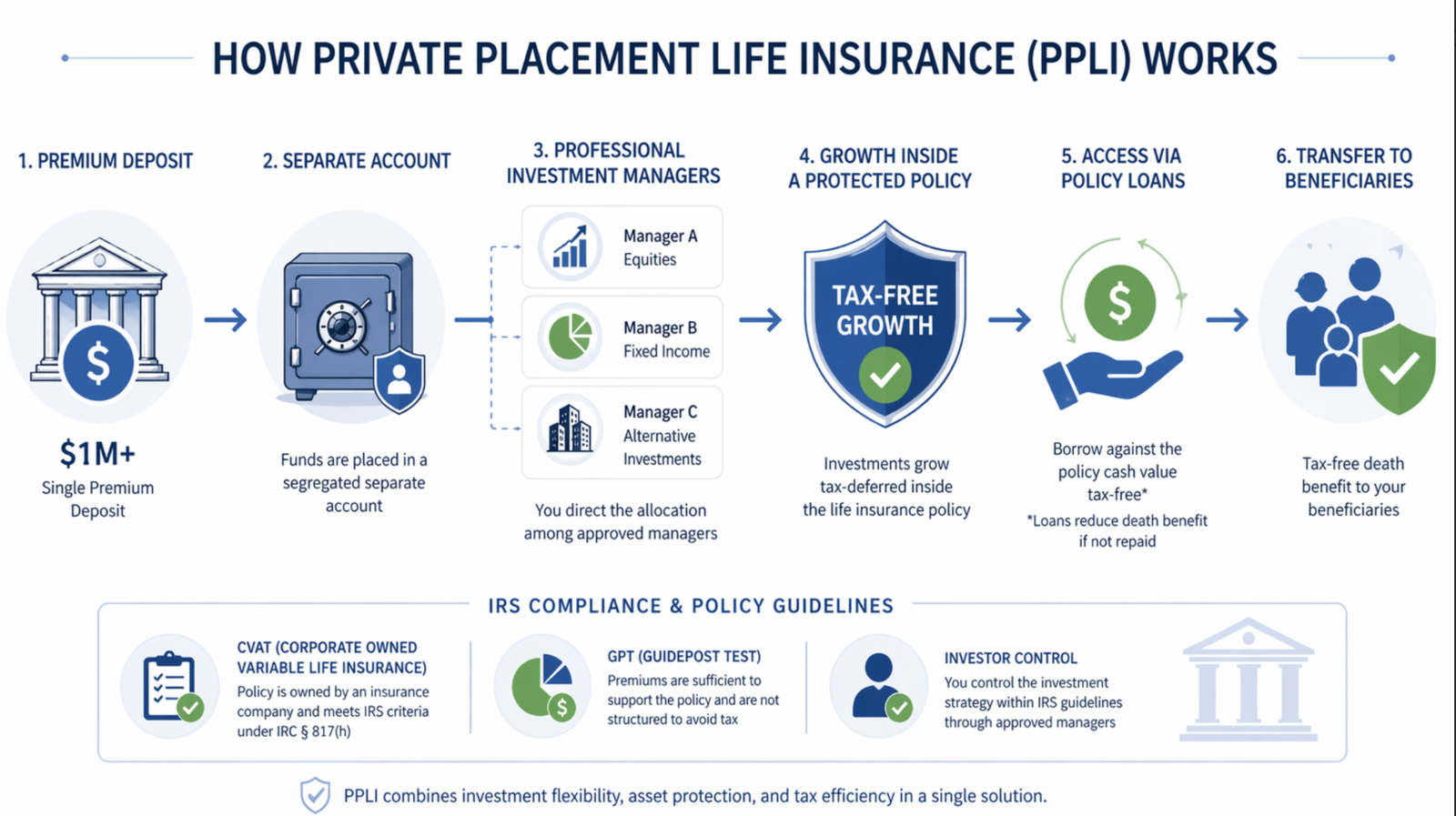
With private placement life insurance, the process often starts with a large premium, hypothetically ranging from $1 million to $5 million or more. That premium is placed into a separate account within the policy, and the cash value is allocated to approved investment managers and strategies.
To maintain its intended tax treatment under current law, the policy has to meet specific IRS requirements under IRC §7702. That typically includes meeting one of two tests: the Cash Value Accumulation Test (CVAT) or the Guideline Premium and Cash Value Corridor Test (GPT). These rules help determine whether the contract is treated as life insurance for tax purposes rather than as a taxable investment account.
There are also “investor control” rules to follow. In simple terms, you can choose the investment strategy or manager, but you typically cannot directly control individual trades. Think of it as: you choose the manager, not the day-to-day decisions.
Over time, the investments may grow inside the policy. If structured and managed correctly, you can access that value through policy loans in a way that may be tax-advantaged, depending on whether the policy is treated as a Modified Endowment Contract (MEC) under IRC §7702A, which can change how loans and withdrawals are taxed. The investment options also need to meet diversification requirements under IRC §817(h).
At death, the policy benefit, including any investment gains, is generally paid to beneficiaries income-tax-free under current law (IRC §101(a)). When combined with an irrevocable life insurance trust (ILIT), it may also be removed from your taxable estate.
Private Placement Life Insurance Tax Benefits

The primary reason people consider PPLI is for the potential tax advantages under current law, and the trade-offs that come with the structure.
- Tax-Deferred Growth: Unlike a taxable brokerage account, you’re not typically paying annual taxes on dividends, interest, or capital gains inside the policy. This reduces “tax drag,” allowing more capital to stay invested.
- Tax-Advantaged Access: You may be able to access funds through properly structured policy loans which are generally not treated as taxable income under current law (subject to MEC rules).
- Income-Tax-Free Death Benefit: The benefit is generally paid to beneficiaries income-tax-free under IRC §101(a).
- Reduced Reporting: Because the policy is the legal owner of the underlying assets, you may not receive K-1 tax forms in the same way you would in a taxable account.
- Estate Planning & Creditor Protection: When held inside an ILIT, values may be excluded from your taxable estate. Some jurisdictions also provide asset-protection features for cash value.
To put this into context, consider a hypothetical high earner paying 23.8% on capital gains and up to 37% on ordinary income. Inside a PPLI structure, that annual tax drag may be deferred, which can change long-term compounding over 10–20 years.
Who Qualifies for PPLI (And Who It’s Not For)
PPLI is designed for accredited investors and, in some offerings, “qualified purchasers.”
- Accredited Investor: Generally an individual with a net worth exceeding $1 million (excluding primary residence) or an annual income exceeding $200,000 ($300,000 jointly).
- Qualified Purchaser: Commonly discussed as owning at least $5 million in investments.
This type of high net worth life insurance tends to work best for individuals who have large taxable investment portfolios, a long time horizon (10+ years), interest in alternative investments, and estate planning needs. It is generally not practical for smaller portfolios or short-term liquidity needs.
PPLI vs. Traditional Life Insurance
- Traditional Variable Universal Life (VUL): Built for a broader audience with a limited selection of retail mutual fund subaccounts and potentially higher internal fees.
- PPLI: Designed for much larger premiums and offers access to institutional-quality investments, including certain hedge funds and private equity strategies not available in retail policies. It can be highly customized but requires ongoing professional coordination to maintain tax compliance.
Working With an Advisor on PPLI
Setting up PPLI requires coordination between an insurance advisor to structure the policy, an investment manager to handle the separate account, and an estate planning attorney to integrate the trust.
At Liberty One, we take an evaluation-first approach. We help you understand how PPLI works in your specific situation—your tax exposure, your investment strategy, and your long-term goals—so you can decide whether it fits before taking the next step.
Frequently Asked Questions
PPLI is a variable universal life policy designed for high-net-worth individuals who meet “accredited investor” standards. It allows the allocation of cash value to institutional investments like hedge funds or private equity inside a life insurance structure, allowing growth to be tax-deferred under current law.
It is limited to accredited investors and qualified purchasers. Most programs require large premium commitments, often hypothetically starting at $1–$2 million+, with some requiring $3 million or more over 3–5 years.
The main benefits are tax-deferred growth and potential tax-advantaged access to funds via loans. It may reduce annual taxes on interest, dividends, and gains, and the death benefit is generally paid income-tax-free under current law.
Many programs are built around premium commitments of $1–$2 million+, though this varies by carrier and platform. This level of funding is typically needed to offset policy costs and make the tax advantages meaningful.
PPLI offers access to alternative strategies (hedge funds, private equity) rather than just retail mutual funds. It generally features a lower-cost institutional pricing structure at high funding levels but requires significantly higher minimum premiums and stricter compliance.
Conclusion: Is PPLI Right for You?
Private placement life insurance can be a useful way to potentially reduce tax drag, but it depends on the structure and a long investment horizon. It is a specialized strategy with meaningful minimums.
At Liberty One, we can walk through your options with you and help you decide if this approach makes sense for your situation, based on the policy structure and your goals.
Disclosure: Liberty One Wealth Advisors (“LOWA”) is registered with the Securities and Exchange Commission as an investment adviser. This content is for educational purposes only and does not constitute a recommendation for any specific insurance product. PPLI involves significant costs, fees, and complex tax rules. All examples are hypothetical and for illustrative purposes only. Consult with a qualified tax, legal, and insurance professional regarding your specific circumstances.