Introduction

Retirement can bring a new challenge for high-income retirees: deciding how to sequence withdrawals once paychecks stop. If you have a taxable brokerage account, a traditional IRA, a 401(k), and Roth assets, the order in which you withdraw funds may affect the tax treatment of retirement income over time. Tax-efficient retirement withdrawal strategies involve coordinating income across account types while considering taxes, Medicare costs, and Social Security taxation within a broader high-income retirement planning framework.
This article is for informational and educational purposes only and is not investment, tax, or legal advice. Liberty One Wealth Advisors, LLC is an SEC-registered investment advisor. Please consult a qualified professional regarding your specific circumstances.
Consider a retiree approaching age 73 with a sizable traditional IRA, a healthy brokerage account, and plans to begin Social Security in the next few years. As required minimum distributions begin, withdrawals from a large traditional IRA may increase taxable income and may affect Medicare surcharges and the taxation of Social Security benefits, depending on individual circumstances. Understanding how these moving parts interact can help clarify withdrawal-sequencing considerations within a broader financial plan.
In this guide, we’ll walk through the key factors that influence retirement income planning, including withdrawal sequencing, account types, Social Security taxation, Roth conversion opportunities, RMDs, the Income-Related Monthly Adjustment Amount (IRMAA), and qualified charitable distributions (QCDs). These considerations are often part of a broader [comprehensive retirement planning] discussion.
Why Order of Withdrawal Matters for High-Income Retirees
Many retirees focus on how much they need to withdraw each year. Just as important is where those withdrawals come from. Two retirees with similar portfolios and spending needs can end up with very different tax outcomes based on the order in which they draw from their accounts.
This is one reason tax-efficient retirement strategies often focus on long-term tax considerations rather than a single year’s tax outcome. A withdrawal with a lower current-year tax effect may leave more assets in tax-deferred accounts, which could affect future RMDs, Medicare surcharges, and tax treatment over time.
For high-income retirees, retirement planning often becomes a balancing act between current and future tax considerations. Rather than viewing each year in isolation, it can be helpful to evaluate how today’s decisions may affect income, taxes, and retirement flexibility over the next decade or more.
A Simple Example
Imagine two retirees, each with:
- $2 million in retirement assets
- Similar spending needs
- Similar investment returns
The first retiree withdraws primarily from tax-deferred accounts, such as a traditional IRA. The second uses a more coordinated approach, drawing from taxable accounts while selectively managing tax-deferred withdrawals and preserving Roth assets.
Over time, the second approach may result in a different pattern of taxable income, RMDs, and available account balances. The exact outcome depends on individual circumstances, but the example highlights why withdrawal sequencing matters.
The Three-Bucket Framework
One of the most useful ways to think about retirement income planning is through the three-bucket framework:
- Taxable accounts
- Tax-deferred accounts
- Roth accounts
Each bucket is taxed differently, and each can serve a different purpose in your overall retirement withdrawal strategy.
The purpose is not necessarily to draw down one bucket completely before moving to the next. Instead, tax-efficient withdrawals in retirement may involve coordinating all three buckets in a way that reflects your tax situation, income needs, and long-term planning considerations.
Before discussing Social Security, Roth conversions, and Medicare planning, it’s important to understand how each of these account types works.
The Three Buckets: Taxable, Tax-Deferred, and Roth Accounts
Most retirement portfolios contain assets spread across multiple account types. Understanding how each account is taxed provides the foundation for evaluating a retirement withdrawal plan.
Taxable Accounts
Taxable accounts generally include brokerage accounts, individual investment accounts, and jointly owned investment portfolios.
These accounts are taxed differently from retirement accounts because you typically pay taxes on interest, dividends, and realized gains as they occur. When investments are sold, long-term capital gains may receive tax treatment that differs from ordinary income.
For many retirees, taxable accounts provide flexibility. Because withdrawals themselves are not automatically treated as ordinary income, these accounts can help fill income needs while potentially managing taxable income levels.
Tax-Deferred Accounts
Tax-deferred accounts include:
- Traditional IRAs
- Traditional 401(k) plans
- SEP IRAs
- SIMPLE IRAs
- Other pre-tax retirement plans
Contributions to these accounts may have received tax advantages when the funds were deposited. In exchange, withdrawals are generally taxed as ordinary income during retirement.
Tax-deferred accounts can become significant tax planning considerations for affluent retirees. Years of contributions and investment growth may create large account balances, which can eventually generate substantial RMDs once required distributions begin.
This is one reason a thoughtful tax-efficient retirement withdrawal strategy often includes evaluating how and when tax-deferred assets are used.
Roth Accounts
Roth accounts are funded with after-tax dollars. Qualified withdrawals are generally tax-free, provided applicable rules are met.
Common Roth account types include:
- Roth IRAs
- Roth 401(k)s
- Roth accounts created through conversions from traditional retirement accounts
One key advantage of Roth IRAs is that they generally do not require lifetime RMDs for the original account owner. This can create additional flexibility when managing retirement income and tax exposure.
For high-income retirees, Roth assets may be considered when withdrawals from other sources could increase taxable income or affect Medicare costs.
Comparing the Three Buckets
| Account Type | Tax Treatment | RMDs? | Typical Planning Role |
|---|---|---|---|
| Taxable Account | Interest, dividends, and realized gains may be taxable annually | No | Potential source of income with different tax treatment from tax-deferred withdrawals |
| Tax-Deferred Account | Withdrawals generally taxed as ordinary income | Yes, under current IRS rules | Income source but potential future tax exposure |
| Roth Account | Qualified withdrawals generally tax-free | Roth IRAs generally have no lifetime RMDs for the original owner | Qualified tax-free withdrawals and potential long-term flexibility |
Why High-Income Retirees Need All Three Buckets
Each account type offers different planning opportunities. Taxable accounts may provide flexibility, tax-deferred accounts can support income needs, and Roth assets may help create tax diversification, or retirement assets with different tax treatment.
Retirement income strategies may draw from all three buckets rather than relying heavily on a single source of retirement income. By coordinating withdrawals across account types, you may be able to consider taxable income from year to year while maintaining flexibility as tax laws and personal circumstances change.
With the account structure in place, the next step is understanding how retirement income decisions interact with Social Security benefits and the rules that determine whether those benefits become taxable.
Social Security Claiming and Provisional Income
For many retirees, Social Security becomes an important part of their retirement income plan. What surprises some high-income retirees is that Social Security benefits can become partially taxable depending on income from other sources.
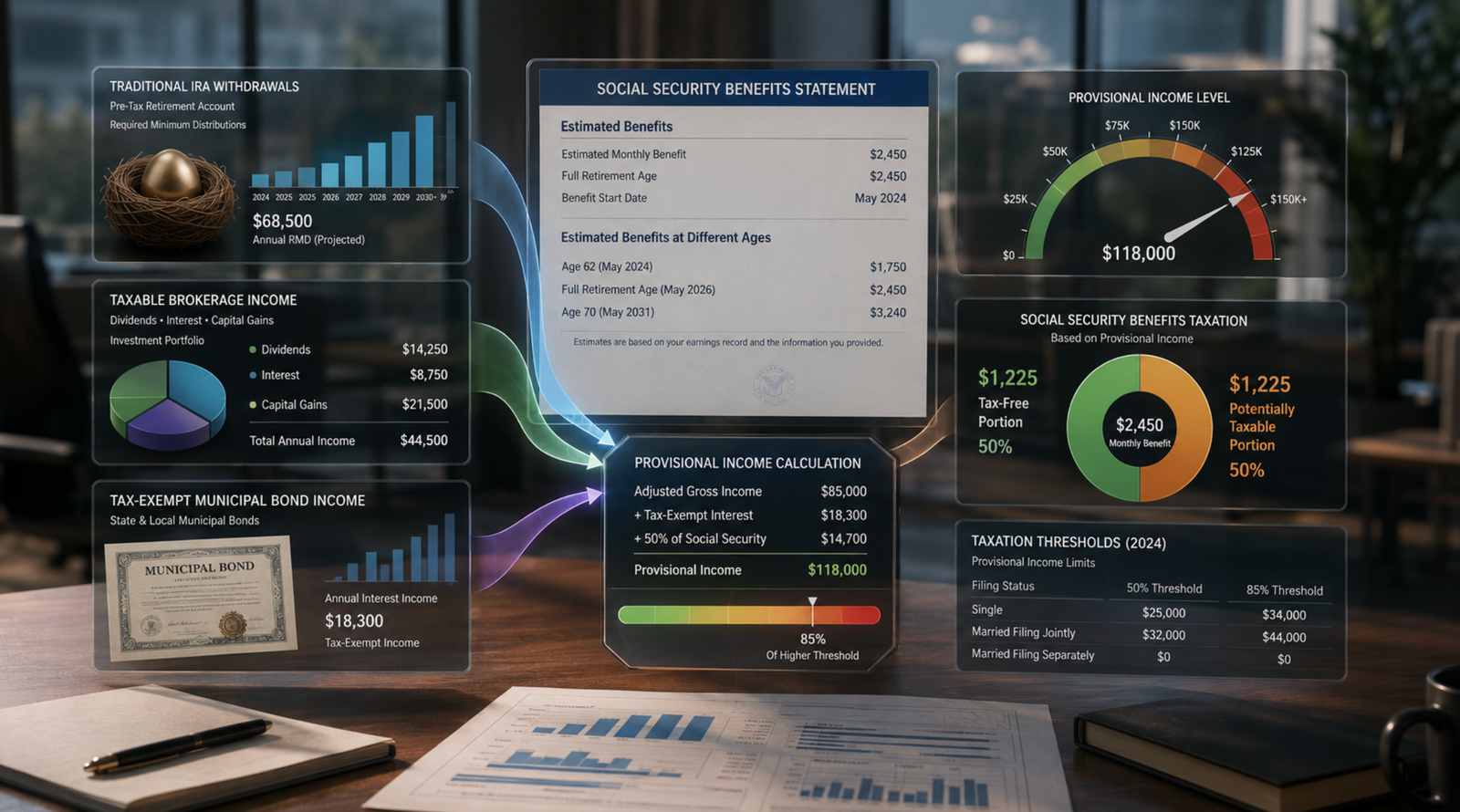
The IRS uses a calculation called provisional income to determine whether Social Security benefits are subject to federal income tax.
According to IRS Publication 915, provisional income generally consists of:
- Adjusted gross income (AGI)
- Plus tax-exempt interest income
- Plus one-half of Social Security benefits
For higher-income retirees, up to 85% of Social Security benefits may become taxable under current IRS rules.
Why Provisional Income Matters
Provisional income highlights an important principle of retirement income withdrawal strategies: one income decision can affect another.
For example, large withdrawals from a traditional IRA may increase your provisional income. That increase could result in a larger portion of your Social Security benefits becoming taxable.
Similarly, realizing large capital gains in a taxable account could contribute to the same outcome.
This doesn’t mean you should avoid withdrawals or investment sales. It simply means those decisions may warrant consideration within the broader context of your retirement income plan.
Social Security Timing Considerations
The age at which you claim Social Security may also influence your overall tax picture.
Some retirees choose to delay Social Security benefits while drawing from other assets. In certain situations, this approach may create opportunities to evaluate taxable income before Social Security benefits begin.
Others may coordinate Social Security timing with Roth conversion strategies, which we’ll discuss in the next section. For additional context, see [Social Security timing strategies].
As with most retirement planning decisions, there is rarely a one-size-fits-all answer. The appropriate approach may depend on your income needs, asset mix, tax situation, health considerations, and long-term goals.
Understanding how provisional income works is an important step in creating tax-efficient retirement strategies because it highlights how multiple income sources interact. Once Social Security enters the picture, the focus often shifts toward evaluating future taxable income before additional retirement rules, such as RMDs, begin to apply.
Roth Conversion Windows in Pre-RMD Years
For many high-income retirees, the years between retirement and the start of required minimum distributions (RMDs) can create a planning window. During this period, employment income may have ended, Social Security benefits may not have started yet, and required minimum distributions (RMDs) have not begun. This combination can create what many advisors refer to as the “pre-RMD window.”
A Roth conversion occurs when assets are moved from a traditional IRA or other eligible tax-deferred retirement account into a Roth account. The taxable portion of the converted amount is generally taxed as ordinary income in the year of the conversion, while qualified Roth withdrawals may be tax-free under applicable rules.
A Roth conversion does not necessarily lower taxes overall. Instead, it changes when certain retirement assets are taxed and may affect the tax treatment of future withdrawals.
Why the Pre-RMD Window Matters
Consider a retiree who leaves the workforce at age 65 and plans to delay Social Security until age 70. Between ages 65 and 70, their taxable income may be significantly lower than it was during their working years.
Depending on their situation, this lower-income period could create an opportunity to convert portions of a traditional IRA before future income sources begin stacking on top of one another.
Once Social Security benefits start and RMDs begin, taxable income often increases. By then, Roth conversions may have a greater impact on tax brackets and Medicare costs.
This is why many discussions about creating tax-efficient retirement strategies focus on evaluating conversion opportunities before RMDs become mandatory.
Balancing Opportunity and Risk
Roth conversions may have different tax effects depending on individual circumstances. Because conversions generate taxable income, they can potentially:
- Push income into a higher tax bracket
- Affect the tax treatment of capital gains
- Affect Medicare premiums through IRMAA
- Increase taxation of Social Security benefits
For that reason, many retirees evaluate conversions incrementally rather than converting large balances all at once.
A Roth conversion should be evaluated as part of a broader retirement plan that considers current income, potential future RMDs, Medicare considerations, and estate-planning goals. For additional context, see [Roth conversion planning].
For retirees looking at retirement withdrawal strategies to minimize taxes, the years before RMDs begin may offer an important period for evaluating tax-aware withdrawal and conversion considerations.
RMDs and How to Plan Around Them
Many retirement savers spend decades building tax-deferred accounts. Eventually, however, the IRS requires minimum withdrawals from certain tax-deferred retirement accounts, which are generally included in taxable income.
A Required Minimum Distribution (RMD) is the minimum amount that must be withdrawn annually from certain tax-deferred retirement accounts once you reach the applicable age under current IRS rules. For many retirees, RMDs begin at age 73. For additional context, see [RMD planning guide].
While RMDs may seem straightforward, they can create significant planning challenges for high-income retirees with large account balances.
Why Large RMDs Can Become a Tax Problem
Traditional IRAs and 401(k) accounts often experience decades of tax-deferred growth. As balances increase, so do future RMDs.
For example, a retiree with a substantial traditional IRA balance may eventually be required to withdraw far more than they actually need for living expenses. Even if those funds are not needed, the withdrawal generally remains taxable.
This can create a chain reaction:
- Higher taxable income
- Potential movement into higher tax brackets
- A larger portion of Social Security benefits becomes taxable
- Greater exposure to Medicare surcharges through the Income-Related Monthly Adjustment Amount (IRMAA)
In many cases, the tax challenge is not the RMD itself. The challenge is the cumulative impact RMDs can have on other areas of a retirement plan.
Planning Before RMDs Begin
RMD planning discussions often begin years before age 73.
Potential planning approaches may include:
- Gradual Roth conversions
- Strategic withdrawals from tax-deferred accounts before RMD age
- Coordinating taxable and tax-free income sources
- Evaluating charitable giving strategies such as QCDs
The objective is not necessarily to eliminate future RMDs. Instead, planning may involve evaluating whether future tax-deferred balances and distribution patterns align with broader tax and income considerations.
A thoughtful retirement withdrawal strategy often focuses on evaluating future taxable income rather than simply reacting to RMDs once they arrive.
RMDs and the Bigger Retirement Picture
One of the most important concepts for affluent retirees is that RMDs rarely operate in isolation.
A larger-than-expected RMD can influence:
- Federal income taxes
- Medicare costs
- Social Security taxation
- Estate planning decisions
That is why a comprehensive tax-efficient retirement withdrawal strategy typically evaluates future RMD exposure well before distributions become mandatory.
IRMAA Thresholds and Medicare Surcharge Planning
Many retirees focus heavily on income taxes while overlooking another significant expense: Medicare premiums.
IRMAA, or Income-Related Monthly Adjustment Amount, is a surcharge applied to Medicare Part B and Part D premiums when income exceeds certain thresholds established by Medicare and the Social Security Administration.
For higher-income retirees, crossing an IRMAA threshold can result in higher Medicare costs.
How IRMAA Works
IRMAA is based on your modified adjusted gross income (MAGI). Unlike some retirement planning rules that use current-year income, Medicare generally uses a two-year lookback period.
That means income reported on a prior tax return can influence Medicare premiums two years later.
This timing often catches retirees by surprise.
For example, a Roth conversion completed today could potentially affect Medicare premiums in a future year. The same may be true for:
- Large capital gains
- Significant RMDs
- Business-sale proceeds
- Other one-time income events
Why High-Income Retirees Need to Pay Attention
IRMAA is structured using multiple income tiers. As income rises above each threshold, Medicare premiums increase accordingly.
A retiree may not realize they crossed an IRMAA threshold until receiving a notice regarding higher Medicare costs.
Because the thresholds are tiered, even a relatively small increase in income could move someone into a higher premium bracket depending on their circumstances.
This is one reason high-income retirement planning often involves coordinating tax decisions across multiple years rather than focusing only on the current year.
Roth Conversions, Capital Gains, and IRMAA
Many of the same strategies that may affect tax treatment across multiple years may also affect IRMAA.
For example:
- Roth conversions create taxable income
- Large capital gains increase MAGI
- RMDs add ordinary income
None of these actions are inherently negative. In many situations, they may still make sense.
The key is understanding the trade-offs. In some circumstances, a temporary IRMAA surcharge may be considered alongside other long-term planning factors. In other cases, spreading income across multiple years may affect Medicare costs and related tax considerations.
A Pennsylvania Perspective
For retirees in the Philadelphia area and throughout Pennsylvania, it’s important to remember that state and federal tax rules can differ.
Under current Pennsylvania law, retirement income such as Social Security benefits, pensions, IRA distributions, and 401(k) distributions is generally not subject to Pennsylvania state income tax. While this does not eliminate federal tax considerations, it can influence the overall retirement income picture for Pennsylvania retirees.
Looking Beyond Individual Decisions
A Roth conversion affects taxes.
Taxable income can affect IRMAA.
IRMAA can affect Medicare premiums.
And all of those decisions can influence Social Security taxation and future withdrawal options.
This interconnected nature of retirement planning is why tax-efficient retirement strategies may consider the broader set of tax, Medicare, and income interactions rather than any single tactic. Understanding these interactions creates the foundation for the next topic: charitable giving strategies and their potential role in tax-aware retirement withdrawals.
QCDs and Charitable Giving for Tax-Efficient Withdrawals
For retirees who already support charitable organizations, a Qualified Charitable Distribution (QCD) may provide a way to align charitable giving with retirement income planning.
A Qualified Charitable Distribution (QCD) is a direct transfer from an IRA to a qualified charity by an eligible account owner age 70½ or older. When completed according to IRS rules, a QCD can satisfy all or part of a required minimum distribution while excluding the transferred amount from taxable income.
For high-income retirees, that distinction can be meaningful.
Why QCDs Matter
Many retirees take an RMD, recognize the income, and then make a charitable donation separately. While that approach may still support important causes, its tax treatment may differ from a QCD.
With a QCD, the distribution goes directly from the IRA to the charity. Because the amount is generally excluded from taxable income, it may result in a lower adjusted gross income (AGI) than taking a taxable distribution before making a separate charitable gift.
Depending on individual circumstances, a lower AGI may also affect:
- IRMAA exposure
- The taxation of Social Security benefits
- Overall taxable income
- Charitable giving within a retirement income plan
A Practical Example
Imagine a retiree who is already planning to donate to a favorite local charity. Instead of taking an RMD, paying taxes on the distribution, and then writing a check, they use a QCD to transfer funds directly from their IRA to the organization.
The charitable goal remains the same, but the tax treatment may be different.
For charitably inclined retirees, QCDs may be considered as part of broader retirement income withdrawal strategies because they can bring charitable giving and tax-aware retirement planning considerations together.
How These Strategies Work Together
Each strategy discussed so far serves a different purpose. The key consideration is how they interact within a broader retirement income plan.
Many retirement planning articles discuss Roth conversions, Social Security taxation, RMDs, Medicare premiums, and charitable giving separately. In reality, these decisions are often connected.
A withdrawal decision made today may affect future tax treatment, Medicare premiums, and withdrawal flexibility years from now.
An Example Retirement Timeline
Consider a simplified retirement timeline:
Ages 60–72
- Potential Roth conversion considerations
- Withdrawal sequencing across account types
- Taxable-income considerations before RMDs begin
Age 70½ and Beyond
- Eligibility for Qualified Charitable Distributions
- Charitable-giving considerations involving IRAs
Age 73 and Beyond
- RMDs may begin under current IRS rules
- Potential effects on taxable income
- Medicare and Social Security considerations
Ongoing
- IRMAA thresholds
- Investment income and capital gains
- Withdrawal-plan considerations as circumstances change
The Big Picture
A Roth conversion may change the size of future RMDs.
Changes in RMD amounts may affect taxable income and IRMAA considerations.
Taxable income may also influence the taxation of Social Security benefits.
Meanwhile, QCDs may be relevant to retirees who support charitable causes.
This is why tax-efficient retirement withdrawal strategies are rarely about finding a single “best” withdrawal order. Instead, they focus on coordinating multiple decisions so the interactions among tax treatment, Medicare premiums, Social Security taxation, and withdrawal needs can be evaluated together.
When to Revisit the Plan: Life Events and Tax Law Changes
A retirement withdrawal strategy is generally not a one-time decision.
Retirement plans evolve over time, and tax laws change regularly. What made sense at age 65 may not remain appropriate at age 75.
Periodic reviews can help assess whether your strategy continues to reflect your goals, income needs, and current tax environment.
Life Events That May Require a Review
Several events can significantly change retirement income planning:
- Retirement from full-time work
- The death of a spouse
- Receiving an inheritance
- Selling a business
- Major health changes
- Significant market gains or losses
Each of these events can affect income, taxes, Medicare costs, or estate planning considerations.
For example, the death of a spouse may change filing status and tax brackets. A business sale could create a large one-time income event. An inheritance may increase future RMD exposure if inherited retirement assets are involved.
Tax Rules Continue to Change
Retirement planning rules are not static.
IRS thresholds, standard deductions, RMD regulations, Medicare income thresholds, and other tax provisions are updated periodically. A strategy built around today’s rules may need adjustments in future years.
For that reason, retirees may consider reviewing their withdrawal strategy annually or after major life events.
The Value of Coordinated Planning
Investments, taxes, retirement income, estate planning, and insurance decisions rarely exist in isolation.
A coordinated review can help identify how decisions in one area may affect another. For high-income retirees, these connections often become more important as account balances grow and income sources multiply.
Tax-efficient withdrawal strategies for retirees are not solely about short-term tax considerations. They may involve maintaining flexibility and making informed decisions throughout retirement.
Conclusion
Tax-efficient retirement withdrawal strategies are about more than a single year’s tax considerations. For high-income retirees, decisions around withdrawals, Roth conversions, RMDs, Social Security, IRMAA, and charitable giving often interact and may affect the tax treatment of retirement income over time.
Whether you’re approaching retirement or already taking distributions, a coordinated plan can provide a framework for evaluating how tax rules and personal circumstances may affect your retirement income strategy. Liberty One Wealth approaches these discussions through a broader planning lens that considers your income needs, account structure, tax considerations, and long-term objectives. To discuss how these considerations may relate to your situation, [Talk to a fiduciary advisor].
Frequently Asked Questions
What is the most tax-efficient order to withdraw money in retirement?
There is no single withdrawal order that works for everyone. An appropriate approach depends on your tax bracket, expected future income, Social Security timing, required minimum distributions (RMDs), and Medicare considerations. In many cases, high-income retirees use a combination of taxable accounts, tax-deferred accounts, and Roth assets as part of a broader tax-efficient retirement withdrawal strategy rather than following a rigid formula.
How do required minimum distributions affect my tax bill as a high-income retiree?
Required minimum distributions (RMDs) are the minimum amounts the IRS requires you to withdraw from certain tax-deferred retirement accounts beginning at age 73 under current rules. Because RMDs are generally taxed as ordinary income, large account balances can push you into higher tax brackets, increase the taxable portion of your Social Security benefits, and potentially trigger higher Medicare premiums through IRMAA. Planning before RMDs begin may help you evaluate these potential tax and Medicare considerations over time.
What is IRMAA, and how can I avoid triggering Medicare surcharges?
IRMAA, or Income-Related Monthly Adjustment Amount, is an additional Medicare Part B and Part D charge that applies when your income exceeds certain thresholds. The surcharge is based on income reported two years earlier, so decisions such as Roth conversions, large capital gains, or sizable RMDs can affect future Medicare costs. While IRMAA cannot always be avoided, careful income planning may help you manage your exposure to higher surcharge tiers.
When does a Roth conversion make sense for someone already in retirement?
A Roth conversion may warrant evaluation during years when your taxable income is lower than expected, particularly between retirement and age 73 when RMDs begin. For example, some retirees delay Social Security benefits while gradually converting portions of a traditional IRA to a Roth account. Depending on your situation, this strategy may change the size of future RMDs and the tax treatment of qualified Roth withdrawals. The conversion itself is a taxable event and may warrant discussion with a qualified professional.
What is a qualified charitable distribution (QCD), and who can benefit from it?
A qualified charitable distribution (QCD) allows eligible IRA owners age 70½ or older to transfer funds directly from an IRA to a qualified charity, subject to current IRS limits. A QCD can satisfy all or part of an RMD while keeping the distributed amount out of taxable income. For charitably inclined retirees, a QCD may be considered as part of retirement income planning. Depending on individual circumstances, excluding the distribution from taxable income may affect adjusted gross income, IRMAA considerations, or the taxation of Social Security benefits.
How does provisional income determine how much of my Social Security is taxed?
The IRS uses a formula called provisional income to determine whether a portion of your Social Security benefits is taxable. Provisional income equals your adjusted gross income, plus any tax-exempt interest, plus one-half of your Social Security benefits. According to IRS Publication 915, up to 85% of Social Security benefits may become taxable for higher-income retirees, making withdrawal timing and income sources relevant considerations in retirement planning.