Introduction
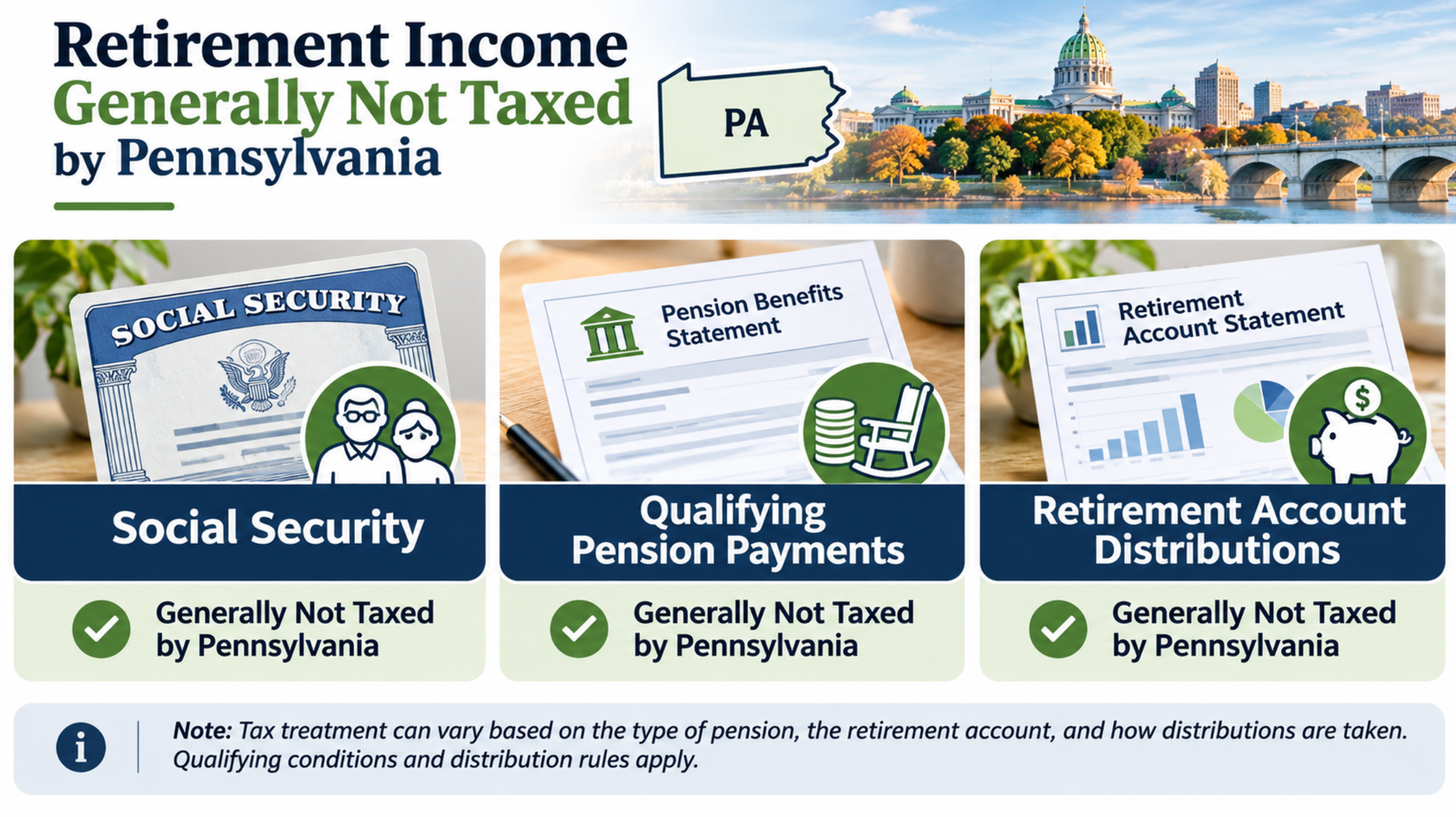
Does Pennsylvania tax retirement income? Pennsylvania generally does not tax Social Security benefits, qualifying pension payments, or eligible distributions from retirement accounts. Wages, interest, dividends, net capital gains, and net rental income may still be subject to Pennsylvania income tax.
Understanding Pennsylvania retirement income tax rules can help you estimate how much income you may have available to spend in retirement. Philadelphia’s Wage Tax may also apply to employment income if you live or work in the city. Federal taxes may still apply even when Pennsylvania does not tax a particular source of income.
Pennsylvania Retirement Income Tax at a Glance
Pennsylvania’s tax treatment depends on the source of your income. For pensions and retirement plan distributions, treatment may also depend on the type of plan, its retirement requirements, and when you receive the money.
| Retirement Income Type | Taxed by PA? |
|---|---|
| Social Security benefits | Generally no |
| Qualifying pension payments | Generally no, if the distribution meets Pennsylvania’s requirements for retirement benefits |
| 401(k) and 403(b) distributions | Generally no when they qualify as retirement benefits under Pennsylvania law |
| 457(b) distributions | Depends on the type of plan and circumstances of the distribution |
| Traditional IRA distributions | Generally no at age 59½ or later; earlier distributions may receive different treatment |
| Roth IRA distributions | Generally no when Pennsylvania’s applicable requirements are satisfied; earlier distributions may receive different treatment |
| Military retirement pay | Generally no when paid after qualifying for retirement based on age or years of service |
| Part-time wages | Generally yes |
| Interest and dividends | Generally yes |
| Net capital gains | Generally yes |
| Net rental income | Generally yes |
Pennsylvania may tax some early or nonqualifying retirement distributions, generally after taking into account previously taxed contributions. Federal income tax may still apply to income Pennsylvania exempts.
Pennsylvania’s tax system differs from the federal income tax system, so federal and Pennsylvania treatment of the same distribution may not be identical. The Pennsylvania Department of Revenue specifically notes that Pennsylvania personal income tax differs from the federal Internal Revenue Code.

What Pennsylvania Does Not Tax
Several common sources of retirement income are generally not taxed by Pennsylvania. For pensions and retirement account distributions, however, the exemption may depend on the type of plan and the circumstances of the distribution.
Does Pennsylvania Tax Social Security?
No. Pennsylvania does not tax Social Security retirement benefits.
Federal income tax may still apply. For federal tax purposes, your combined income generally includes half of your Social Security benefits plus certain other income, including tax-exempt interest. Your combined income and filing status help determine whether a portion of your Social Security benefits is taxable federally.
Before claiming Social Security, compare your estimated monthly benefit at different ages with your other income sources and expected expenses.
Our guide to Social Security claiming strategy discusses some of these considerations.
Does PA Tax Pensions?
Generally, Pennsylvania does not tax payments that qualify as retirement benefits under Pennsylvania law.
The Pennsylvania Department of Revenue identifies payments commonly recognized as old-age or retirement benefits to people who have retired after reaching a specified age or completing a stated period of employment as excluded from taxable compensation.
If you receive pension payments before satisfying the applicable retirement requirements, some or all of the distribution may receive different Pennsylvania tax treatment. Federal income tax may also apply even when Pennsylvania does not tax the payment.
For additional information, see the Pennsylvania Department of Revenue.
If your pension offers different payout options, see our guide to lump-sum or monthly pension payments.
401(k), 403(b), 457(b), and IRA Withdrawals
Pennsylvania generally does not tax retirement distributions that qualify under its rules. The treatment depends on the type of account and the circumstances under which the money is distributed.
Traditional 401(k) and 403(b) plans. Distributions are generally exempt from Pennsylvania income tax when they qualify as retirement benefits under Pennsylvania law, including applicable age or service requirements. Early or nonqualifying distributions may receive different treatment.
457(b) deferred compensation plans. Pennsylvania tax treatment can depend on the type of 457(b) plan and the circumstances of the distribution.
Traditional IRAs. Distributions at age 59½ or later are generally exempt from Pennsylvania income tax. Earlier distributions may receive different treatment depending on the circumstances.
If you retire at a younger age after satisfying an eligible workplace plan’s retirement requirements, distributions from that plan may receive different Pennsylvania tax treatment than a traditional IRA distribution taken at the same age. The specific plan and Pennsylvania rules applicable to the distribution should be reviewed before making a withdrawal.
When an early distribution is taxable, Pennsylvania generally takes previously taxed contributions into account in determining the taxable amount.
Federal income tax may still apply to distributions from these accounts.
If you have access to both workplace plans, our guide to 457(b) and 403(b) plans explains some of their differences.
Does Pennsylvania Tax Military Retirement?
Pennsylvania generally does not tax military retirement benefits paid after you qualify for retirement based on age or years of service.
Other income you earn during retirement, such as wages or net rental income, is treated separately. Federal income tax may also apply to military retirement pay.
What Pennsylvania Still Taxes in Retirement
Pennsylvania generally imposes its 3.07% personal income tax on taxable compensation and several other classes of income, including taxable interest, dividends, net gains, and net rental income. The Commonwealth identifies eight separate classes of income subject to Pennsylvania personal income tax.
Examples of income that may remain taxable during retirement include:
- Part-time wages and taxable compensation
- Net income from consulting or a business
- Taxable interest, including interest from many bank and savings accounts
- Dividends from investments held in taxable accounts
- Net gains from selling investments or other property
- Net rental income
Federal income tax may also apply. Factoring both federal and state taxes into your retirement plan can provide a better estimate of your after-tax spending capacity.
For more information, see our article on tax-efficient investing in Pennsylvania.
Philadelphia and Local Taxes for Retirees
Retirees living or working in Philadelphia should also consider local taxes.
Philadelphia Wage Tax
Pension payments are generally not subject to Philadelphia Wage Tax. The City of Philadelphia lists pension payments among types of income that may not be subject to Wage Tax.
Employment income is treated differently. Philadelphia residents generally owe Wage Tax on employment compensation regardless of where they work, while nonresidents generally owe Wage Tax on compensation for work performed in Philadelphia.
If you are self-employed, net consulting income may instead be subject to Philadelphia’s Net Profits Tax.
Our guide to the Philadelphia Wage Tax discusses resident, nonresident, remote-work, and refund considerations.
Sales and Property Taxes
Philadelphia’s combined sales tax rate is 8% on taxable purchases, consisting of Pennsylvania’s 6% sales tax plus the city’s 2% local sales tax.
The Pennsylvania Property Tax/Rent Rebate Program may provide assistance to eligible homeowners and renters, including qualifying adults age 65 and older. Eligibility, income limits, and rebate amounts can change, so retirees should confirm the current requirements before applying.
Planning Considerations Created by Pennsylvania’s Rules
The timing and source of retirement distributions can affect state and federal taxes, Medicare premiums, and the amount ultimately passing to beneficiaries.
Retiring Before 59½ or Before Pension Eligibility
Pennsylvania may tax part of an IRA distribution taken before age 59½. A distribution from a workplace retirement plan or pension may also receive different tax treatment if it does not qualify as a retirement benefit under Pennsylvania law.
Federal early-distribution rules are separate and may also apply.
If you expect a gap between your final paycheck and the point at which your retirement distributions qualify for favorable Pennsylvania treatment, consider how you will cover your spending needs during that period.
Roth Conversions
A Roth conversion involves moving assets from a traditional retirement account into a Roth IRA.
Pennsylvania generally treats a properly completed conversion differently from a distribution in which funds are retained by the account owner. The state tax consequences can depend on how the conversion is completed and the amount actually transferred to the Roth IRA.
Federal income tax generally applies to previously untaxed amounts converted from a traditional IRA to a Roth IRA during the year of conversion.
Because Pennsylvania and federal rules differ, the tax impact of a Roth conversion should be evaluated separately at each level.
Our article on Roth conversions discusses factors to consider when deciding whether and when to convert.
Roth IRA Withdrawals
Pennsylvania’s treatment of Roth IRA distributions can differ from the federal rules.
Pennsylvania generally does not tax distributions to the extent they represent previously taxed contributions. The treatment of earnings and earlier distributions depends on the circumstances and applicable Pennsylvania rules.
Federal Roth IRA rules are separate. Whether earnings can be withdrawn federally tax-free depends in part on satisfying the applicable five-year rule and other requirements.
See IRS Publication 590-B for federal IRA distribution rules.
The Federal Side Still Applies
Pennsylvania’s favorable treatment of certain retirement income does not eliminate federal income taxes.
Federal income tax may apply to:
- A portion of Social Security benefits, depending on income and filing status.
- Traditional 401(k), 403(b), and IRA distributions, including required minimum distributions.
- Pension income.
- Roth conversions.
- Investment income.
Another consideration is Medicare’s Income-Related Monthly Adjustment Amount (IRMAA). IRMAA can increase Medicare Part B and Part D premiums when income exceeds specified thresholds. The Social Security Administration generally determines IRMAA using federal tax information from two years before the applicable premium year.
Large taxable distributions or Roth conversions can therefore affect future Medicare premiums.
See our guides to Medicare IRMAA brackets and tax-efficient retirement withdrawal strategies.
Pennsylvania Inheritance Tax
Pennsylvania inheritance tax is separate from Pennsylvania income tax and may apply when assets pass to beneficiaries after death.
Current rates generally depend on the beneficiary’s relationship to the decedent:
- 0% for transfers to a surviving spouse
- 4.5% for transfers to lineal heirs, such as children and grandchildren, subject to applicable exceptions
- 12% for transfers to siblings
- 15% for certain other taxable beneficiaries
See the Pennsylvania Department of Revenue’s inheritance tax guidance for current rules.
Retirement accounts can also be subject to Pennsylvania inheritance tax depending on the facts, including the owner’s age and circumstances at death.
Reviewing your retirement-income plan and estate plan together can help you evaluate both your lifetime tax exposure and the amount your beneficiaries may ultimately receive.
For more information, read our guide to Pennsylvania inheritance tax.
Tax Considerations for Retiring in Pennsylvania
Pennsylvania can provide favorable state income tax treatment for retirees who receive Social Security, qualifying pension income, and eligible retirement-plan distributions.
However, taxes are only one part of the retirement decision. Pennsylvania residents may also need to consider:
- Property taxes
- Taxation of investment income
- Pennsylvania inheritance tax
- Philadelphia and other applicable local taxes
- Housing and healthcare costs
- Proximity to family
- Overall cost of living
The appropriate retirement location depends on your income sources, assets, lifestyle, and long-term priorities.
How a Retirement Plan Puts These Rules to Work
A comprehensive retirement plan can help you determine when to draw from different accounts and estimate how much income you may have available after Pennsylvania and federal taxes.
For example, you can compare expected expenses against income from Social Security, pensions, investments, and retirement accounts to determine how much you may need to withdraw each year. Your plan can also incorporate Medicare costs and the assets you would like to leave to your family.
At Liberty One Wealth Advisors, we help individuals and families evaluate these decisions as part of retirement planning in Philadelphia.
If you are approaching retirement or already retired, you can schedule a complimentary Q&A to discuss your questions with our team.
Before making tax-related decisions, confirm how the applicable rules apply to your circumstances with a qualified tax professional.
Pennsylvania Retirement Tax FAQ
How Much of My Retirement Income Is Taxable in PA?
Pennsylvania generally does not tax Social Security benefits, qualifying pension payments, or eligible retirement-plan distributions.
Wages, taxable interest and dividends, net gains, business income, and net rental income are generally subject to Pennsylvania’s 3.07% personal income tax. The Pennsylvania Department of Revenue identifies these among the Commonwealth’s taxable classes of income.
Federal income tax may still apply to retirement distributions and other income even when Pennsylvania does not tax them.
Do I Have to Pay State Tax on 401(k) Withdrawals in PA?
Pennsylvania generally does not tax 401(k) distributions when they qualify as retirement benefits under Pennsylvania law, including applicable age or service requirements.
If a distribution does not qualify, Pennsylvania may tax some of the distribution after taking into account applicable previously taxed contributions.
Federal income tax may still apply to traditional 401(k) withdrawals, and certain earlier distributions may also be subject to additional federal tax.
What Tax Breaks Do Seniors Get in PA?
Pennsylvania generally does not tax Social Security benefits or qualifying retirement benefits.
Eligible older homeowners and renters may also qualify for Pennsylvania’s Property Tax/Rent Rebate Program based on income and other program requirements.
Eligibility and benefit amounts should be confirmed under the rules applicable to the year for which the rebate is claimed.
Does PA Tax Roth IRA Withdrawals?
Pennsylvania generally does not tax Roth IRA distributions to the extent they represent previously taxed contributions. The treatment of earnings and earlier distributions depends on the facts and applicable Pennsylvania rules.
Federal Roth IRA rules are separate. Federal income tax may apply to earnings if the distribution does not satisfy the applicable requirements, including the five-year rule where relevant.
Do I Owe Philadelphia Wage Tax on My Pension?
Pension payments are generally not subject to Philadelphia Wage Tax. The City of Philadelphia identifies pension payments among income that may be excluded from Wage Tax.
Employment income is different. Philadelphia residents generally owe Wage Tax on employment compensation regardless of where they work, while nonresidents generally owe Wage Tax for work performed in Philadelphia.
Self-employment or consulting income may instead be subject to Philadelphia’s Net Profits Tax.
Is Pennsylvania Tax-Friendly for Retirees?
Pennsylvania can provide favorable state income tax treatment for retirees whose income consists substantially of Social Security, qualifying pensions, and eligible retirement-plan distributions.
However, taxable investment income, property taxes, local taxes, and Pennsylvania inheritance tax may affect the overall cost of retirement.
Whether Pennsylvania is advantageous for a particular retiree therefore depends on their income sources, assets, residence, estate plan, and overall financial circumstances.
Disclosure
This material is provided for educational and informational purposes only and should not be construed as individualized investment, tax, or legal advice. Tax laws, regulations, rates, thresholds, and their application depend on individual circumstances and may change over time. Please consult your tax and legal professionals regarding your specific circumstances.
Liberty One Wealth Advisors is an SEC-registered investment adviser. Registration does not imply a certain level of skill or training. For information regarding our advisory services, fees, and conflicts of interest, please review our Form ADV Part 2A and Form CRS.