Intro – The Planning Opportunity Before a Liquidity Event

If you’re a founder, early employee, or investor preparing for a company sale, acquisition, or IPO, you may have recently heard about the QSBS tax exclusion and wondered whether it applies to your shares. For founders asking what the QSBS tax exclusion is, qualified small business stock may offer a federal gain-exclusion opportunity under Internal Revenue Code Section 1202, depending on the facts. Another important question is how QSBS fits into your broader financial plan before and after a liquidity event.
This article is for informational and educational purposes only and is not investment, tax, or legal advice. Liberty One Wealth Advisors, LLC is an SEC-registered investment advisor. Please consult a qualified CPA and legal counsel regarding your specific circumstances.
The rules surrounding qualified small business stock (QSBS) changed materially under the One Big Beautiful Bill Act (OBBBA), enacted on July 4, 2025. For qualifying stock acquired after the enactment date, the law revised the Section 1202 holding-period schedule, federal exclusion cap, and corporate eligibility threshold.
These changes make it especially important to confirm which rules apply to your shares. However, the QSBS tax exclusion remains highly technical and fact-specific. Eligibility depends on how the stock was acquired, how long you’ve held it, the type of business involved, and several other requirements.
In this guide, we’ll walk through what QSBS is, who may qualify, how the exclusion works under current law, and how to think about QSBS as part of a larger financial plan that includes tax considerations, estate planning, diversification, and post-exit planning.
What Is Qualified Small Business Stock?
At its core, qualified small business stock is stock issued by an eligible domestic C corporation that meets the requirements of Section 1202 of the Internal Revenue Code. When those requirements are satisfied, shareholders may be able to exclude a portion, or in some cases all, of their qualifying capital gain when the stock is sold.
If you’ve ever asked, “What is qualified small business stock?” or “What is the QSBS tax exclusion?” the answer begins with understanding that not every startup or privately held company qualifies. Section 1202 contains several corporate-level and shareholder-level requirements that must be satisfied before a federal gain exclusion may apply.
Requirement 1: The Company Must Be a Domestic C Corporation
The first requirement is straightforward: the company must be organized and taxed as a U.S. C corporation at the time the stock is issued.
This means that stock originally issued by an LLC, partnership, or S corporation generally does not qualify for QSBS treatment. However, some businesses convert from an LLC to a C corporation as they grow and seek outside investment. In those situations, the timing of the conversion can become an important planning consideration because the QSBS holding period generally begins after qualifying stock is issued by the C corporation.
For founders building venture-backed companies, confirming when the C corporation structure was established can be an important first step in determining potential eligibility.
Requirement 2: The Business Must Operate in a Qualified Trade or Business
Not every industry is eligible for QSBS treatment.
Section 1202 excludes several service-oriented fields where the company’s value is primarily tied to the reputation or skill of its employees. Common examples include:
- Law
- Consulting
- Financial services
- Health services
- Accounting
- Performing arts
- Athletics
Many technology, software, manufacturing, product-development, and innovation-focused businesses may qualify, but eligibility must be reviewed carefully based on the company’s actual activities. The IRS and Section 1202 rules contain detailed definitions and exceptions that should be evaluated with qualified tax counsel.
For founders, one of the most common misconceptions is assuming that a high-growth company automatically qualifies. In reality, industry classification matters just as much as growth potential.
Requirement 3: The Company Must Satisfy the Gross Asset Test
Another key requirement is the corporation’s gross asset level.
Historically, Section 1202 required a corporation’s aggregate gross assets to remain below $50 million immediately before and after stock issuance. OBBBA 2025 revised the gross asset test for certain qualifying stock. Because the applicable threshold and effective date can depend on when stock was issued, the current Section 1202 requirements should be verified with a qualified CPA or legal counsel.
The term aggregate gross assets generally refers to the corporation’s cash plus the adjusted tax basis of its other assets. Importantly, this is not necessarily the same as the company’s market value or fundraising valuation. A startup with a headline valuation well above its tax basis may still require a separate eligibility analysis.
Because the calculation can become complex, especially after multiple funding rounds, eligibility should not be assumed based solely on valuation metrics.
Understanding Basis
You’ll often see the term basis when reading about QSBS.
In simple terms, basis is generally the amount you paid for the stock, adjusted for certain tax events over time. Basis becomes important because several QSBS rules, including exclusion limits discussed later in this article, are partially calculated using your adjusted basis in the stock.
For founders who acquired shares at formation and investors who participated in early financing rounds, the basis can vary significantly depending on how and when the shares were acquired.
The Original Issuance Requirement
One of the most important QSBS rules is often overlooked.
To qualify, shareholders generally must acquire stock directly from the issuing corporation. This is known as the original issuance requirement. Stock purchased from another shareholder on the secondary market generally does not qualify for Section 1202 treatment.
For example, if you purchased shares directly from a startup during a financing round, those shares may satisfy the original issuance requirement. If you bought the same shares from an employee or early investor years later, different rules may apply.
This distinction becomes increasingly important as secondary transactions become more common in private-company markets.
Why Professional Verification Matters
The potential federal QSBS exclusion may be material depending on your facts, but qualification is rarely a simple yes-or-no determination.
Corporate structure, industry classification, gross asset calculations, stock issuance history, conversion events, and shareholder-specific circumstances can all affect eligibility. OBBBA 2025 added new provisions, along with additional complexity in determining which rules apply to particular shares.
Before relying on QSBS in tax planning, a qualified CPA and legal counsel can review your specific facts and help determine whether your shares meet the current Section 1202 requirements.
The Holding Period Rule
Qualifying for QSBS is only the first step. The next question is whether you’ve held the stock long enough to receive the available tax benefits.
Historically, Section 1202 required shareholders to hold qualified small business stock for more than five years before any gain could be excluded. For many founders and early employees, that created an all-or-nothing outcome. An acquisition in year four and a half could produce a different federal tax treatment than an exit six months later.
OBBBA changed that framework for qualifying stock acquired after July 4, 2025, subject to the statute’s effective-date provisions.
The New Tiered Holding-Period Structure
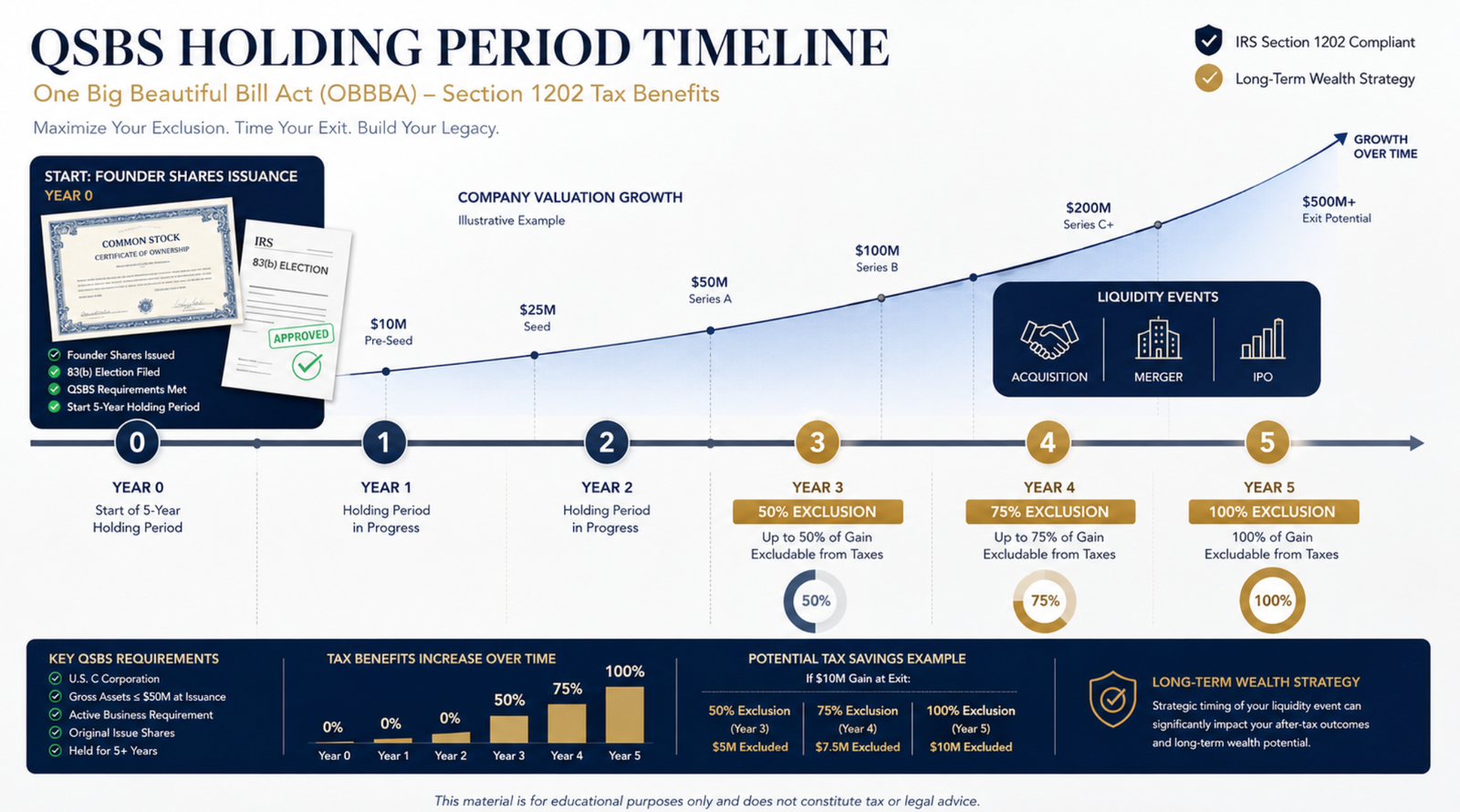
For qualifying QSBS acquired after July 4, 2025, the statute provides a tiered exclusion schedule based on the holding period:
- 50% exclusion after at least 3 years
- 75% exclusion after at least 4 years
- 100% exclusion after at least 5 years
This tiered structure allows for partial exclusions before the five-year mark, provided all other Section 1202 requirements are met.
For stock acquired on or before July 4, 2025, the prior more-than-five-year holding requirement generally remains relevant. The new tiered structure applies only to stock acquired after July 4, 2025, subject to OBBBA’s effective-date rules.
Why Your Timeline Matters
Many founders think about QSBS only when an acquisition offer arrives. In practice, your holding period should be part of your planning years before a potential exit.
Consider a simplified example:
- Year 0: You receive founder shares.
- Year 0: You file an applicable and timely 83(b) election after an early exercise.
- Year 3: You may qualify for a partial exclusion under the new OBBBA rules.
- Year 4: The exclusion percentage increases.
- Year 5: You may qualify for the full federal exclusion.
The difference between selling in year three versus year five could materially affect the amount of gain eligible for exclusion. As a result, the timing of an acquisition, secondary transaction, or liquidity event may deserve careful evaluation alongside broader business considerations.
The Importance of an 83(b) Election
For employees and founders who receive restricted stock or early-exercise stock options, a Section 83(b) election can be an important planning tool.
When a valid Section 83(b) election applies and is timely filed within 30 days of the relevant stock transfer, it may affect when the QSBS holding period begins, depending on the facts. Missing that filing deadline can delay the start of your holding period and potentially affect future eligibility for the exclusion.
Because 83(b) elections involve both tax and legal considerations, they may warrant review with qualified tax and legal professionals before filing.
Transactions That Can Affect Your Holding Period
Not every shareholder journey is straightforward.
Certain hedging arrangements, redemptions, transfers, or restructuring transactions can affect QSBS eligibility or interrupt the holding period calculation. Likewise, stock exchanges, recapitalizations, and trust transfers may involve specialized rules that require careful review.
The key takeaway is simple: a holding period is not necessarily preserved through every corporate transaction. If a significant liquidity event is approaching, confirming QSBS status with qualified tax and legal counsel may be appropriate before decisions are made.
The Federal Exclusion Cap
Even when your stock qualifies, and you’ve satisfied the holding-period requirement, Section 1202 does not provide an unlimited exclusion.
The law places a cap on the amount of gain that may be excluded from federal income tax. Understanding this limit is an important part of QSBS planning because it often shapes decisions around ownership structure, gifting strategies, and estate planning.
The Historical Exclusion Limit
Before OBBBA, the exclusion was generally limited to the greater of:
- $10 million of eligible gain per taxpayer, per issuer, or
- 10 times the taxpayer’s adjusted basis in the stock
For many founders, the $10 million limitation became the practical benchmark because founder shares are often acquired with a relatively low basis.
The New OBBBA Exclusion Cap
For qualifying stock issued after the applicable OBBBA effective date, the law revised the per-taxpayer exclusion cap. The current Section 1202 exclusion cap, applicable dates, and any inflation adjustments should be verified with a qualified CPA or legal counsel.
The alternative limitation based on a 10-times adjusted basis remains relevant under current Section 1202 rules.
For founders, investors, and early employees with substantial appreciation, the current federal exclusion cap may be relevant to tax-aware planning. However, eligibility still depends on satisfying all other Section 1202 requirements.
Why the “Per Taxpayer” Rule Matters
One of the most important concepts in QSBS planning is that the exclusion cap generally applies on a per-taxpayer basis.
This means the exclusion is not necessarily tied to a single family or household. Instead, it applies to each taxpayer who owns qualifying shares and satisfies the applicable requirements.
That distinction becomes particularly important when founders begin evaluating estate-planning and gifting strategies. In limited circumstances, gifts to or transfers involving separate non-grantor trusts may affect how the per-taxpayer limit is analyzed, but these arrangements are highly fact-specific and require coordinated CPA and estate attorney review.
We’ll explore that concept in the next section when discussing QSBS stacking.
Focus on Planning, Not Just the Tax Benefit
The federal QSBS exclusion may be material depending on your facts and the current Section 1202 limits. However, focusing solely on the exclusion amount can cause founders to overlook other important planning decisions.
Liquidity events often affect far more than taxes. They can influence investment allocation, estate planning goals, charitable giving strategies, retirement planning, and long-term family wealth objectives.
For that reason, QSBS is typically considered as one component of a broader financial plan rather than an isolated tax strategy. Coordinated discussions with qualified tax, legal, and financial professionals may help clarify how a potential transaction relates to other planning areas. For additional context, see [how we approach tax and estate planning].
QSBS Stacking: Gifts to Non-Grantor Trusts

Once you’ve determined that your shares qualify for QSBS treatment and you’ve evaluated the applicable exclusion limits, the next question becomes how the ownership structure may be evaluated in connection with broader estate and tax planning.
One strategy frequently discussed in advanced QSBS planning is known as QSBS stacking. The concept is based on a simple but important rule: the Section 1202 exclusion cap generally applies on a per-taxpayer basis.
Because the exclusion is tied to the taxpayer rather than a single family unit, some founders explore whether ownership can be distributed among multiple taxpayers before a liquidity event occurs. Subject to applicable federal and state rules, separate taxpayers may be evaluated independently for purposes of the Section 1202 exclusion cap.
What Is a Non-Grantor Trust?
A non-grantor trust is typically an irrevocable trust treated as a separate taxpayer for income tax purposes.
Unlike a grantor trust, where income is generally reported on the grantor’s personal tax return, a non-grantor trust may file its own tax return and be treated independently under many tax rules. Because it is considered a separate taxpayer, its Section 1202 treatment, including the applicable exclusion cap, may be evaluated separately when all requirements are satisfied.
This distinction forms the foundation of many QSBS stacking discussions.
How QSBS Stacking Works
In simplified terms, a founder may transfer qualifying QSBS shares to one or more properly structured non-grantor trusts before a liquidity event. If the transfer is completed correctly and the trust satisfies the applicable requirements, each trust’s eligibility and applicable exclusion limit may need to be evaluated separately.
For example, imagine a founder who expects a significant future liquidity event and is already engaged in long-term estate planning. Rather than holding all qualifying shares personally, the founder may explore whether gifting a portion of those shares to separate irrevocable trusts could allow the Section 1202 treatment of each taxpayer’s shares to be assessed separately.
The details become highly technical very quickly. Timing, trust design, state tax rules, beneficiary structures, valuation issues, and anti-abuse provisions can all affect the outcome. What appears straightforward on paper often may require extensive coordination among attorneys, CPAs, trustees, and financial advisors.
The Estate Planning Connection
One reason QSBS stacking receives so much attention is that it can overlap with legitimate estate-planning goals.
If shares are transferred before substantial appreciation occurs, future growth may take place outside the grantor’s taxable estate. In some situations, that means a single planning decision could potentially affect both estate planning and tax considerations.
For founders who expect their company value to grow significantly over time, the timing of gifts may be just as important as the gifting strategy itself.
However, it’s important to remember that estate planning should drive the decision, not simply the tax benefit. A trust structure that does not align with family goals, beneficiary needs, or long-term planning objectives may create additional complexity without serving those broader objectives.
Why Professional Coordination Matters
QSBS stacking is often discussed in headlines because it can appear straightforward. In reality, it is one of the most fact-specific areas of QSBS planning.
The IRS, state tax authorities, trust law requirements, and Section 1202 rules all interact in ways that require careful analysis. A strategy that may align with one founder’s circumstances may not align with another founder’s objectives, estate plan, or tax considerations.
QSBS stacking may warrant coordinated review with a qualified CPA and estate-planning counsel as part of a broader discussion about family wealth transfer, estate planning, and long-term financial goals.
Section 1045 Rollover: Flexibility Before the Full Holding Period
Not every founder reaches a liquidity event after meeting the desired QSBS holding period.
Acquisitions can happen unexpectedly. Strategic buyers may approach a company years before shareholders anticipated a sale. When that happens, Section 1045 may provide an alternative planning option.
What Is a Section 1045 Rollover?
A Section 1045 rollover is a federal tax provision that may allow certain noncorporate taxpayers to defer qualifying QSBS gain when they reinvest in replacement QSBS.
Under Section 1045 of the Internal Revenue Code, a taxpayer who sells qualifying QSBS may defer gain by reinvesting the proceeds into replacement QSBS within a specific time period. The gain is generally recognized only to the extent the sale proceeds exceed the cost of replacement QSBS purchased within 60 days, subject to applicable requirements. Any gain not recognized generally reduces the basis of the replacement stock.
This provision may be relevant when a shareholder exits one qualifying company and is considering an investment in another eligible small business.
The Six-Month Holding Requirement
Section 1045 is not available immediately after acquiring stock.
To qualify, the original QSBS generally must be held for more than six months before the sale. If the shares are sold before that point, the rollover election is typically unavailable.
This requirement limits Section 1045 treatment to stock held beyond a short-term period.
The 60-Day Reinvestment Window
Timing is critical.
After the sale of qualifying QSBS, the taxpayer generally has 60 days to reinvest the proceeds into replacement QSBS. Missing that deadline can affect whether a Section 1045 deferral is available.
For founders involved in merger or acquisition negotiations, Section 1045 tax considerations may need to be addressed before closing. Once a transaction is complete, the planning window may be relatively short.
When Might a Founder Use a Section 1045 Rollover?
A common example involves a founder whose company is acquired before the full QSBS holding period is reached.
Imagine a founder who has held qualifying stock for three years when a strategic buyer offers to acquire the business. The founder may not yet qualify for the maximum available Section 1202 benefit. Depending on the circumstances, a Section 1045 rollover may provide an opportunity to defer eligible gain while purchasing replacement QSBS, subject to the applicable requirements.
A replacement investment should be evaluated based on its own risk, liquidity, time horizon, and role in your broader financial plan, not tax treatment alone.
A Planning Tool, Not a Universal Solution
Section 1045 can be relevant in the right circumstances, but it is not automatically the best answer for every founder.
The strategy requires identifying replacement QSBS opportunities, evaluating investment risk, understanding timing requirements, and coordinating with legal and tax advisors. In some circumstances, a rollover may not align with an investor’s broader objectives or the available replacement investments.
The key takeaway is that founders facing an early acquisition may have Section 1045 considerations that warrant coordinated review before a transaction closes.
State Tax Treatment: Why PA/NJ Founders Face an Extra Step
Many founders focus on the federal benefits of Section 1202 and assume those benefits automatically apply at the state level. That is not always the case.
The federal QSBS exclusion does not automatically flow through to state income tax returns. Each state decides whether it will conform to Section 1202, create its own rules, or ignore the federal exclusion entirely.
State Conformity Matters
A founder could potentially qualify for a federal exclusion while still owing state income tax on the same gain.
This issue is particularly important for Liberty One Wealth clients in the Philadelphia region because both Pennsylvania and New Jersey generally do not conform to the federal QSBS exclusion. California is another commonly cited example of a non-conforming state.
As a result, a shareholder may receive favorable federal tax treatment while still facing state-level capital gains taxes.
Why This Can Affect Planning Decisions
For founders approaching a liquidity event, state tax exposure can affect the overall tax considerations related to a transaction.
A transaction that appears favorable from a federal tax perspective may look different once state taxes are considered. That’s especially true for founders with large positions, multiple shareholders, or complex trust structures.
In some cases, families explore trust domicile planning or other advanced state-tax strategies. These approaches are highly technical and require careful legal review. State tax authorities often apply detailed rules that can affect whether a strategy achieves its intended outcome.
Review State Rules Before an Exit
State tax laws change independently of federal tax laws.
A strategy that works today may be affected by future legislative changes, administrative guidance, or court decisions. For that reason, founders and investors may want to review state tax treatment with qualified advisors before making decisions based on projected after-tax proceeds.
Understanding both the federal and state picture can help clarify the tax considerations surrounding a potential transaction.
How QSBS Fits Your Broader Financial Plan
Most articles about qualified small business stock stop after explaining eligibility requirements and exclusion percentages.
Those rules are important, but they only answer part of the question.
For many founders, a liquidity event is not simply a tax event. It may represent a significant financial transition that affects multiple areas of your financial life. QSBS planning is therefore often considered within the context of your broader financial plan.
Concentration and Diversification
A successful startup often creates a concentrated position in a single company.
Even if your shares qualify for favorable tax treatment, concentration risk still exists. A tax benefit does not eliminate the financial risk of having a large percentage of your net worth tied to one company.
Questions worth considering include:
- How much of your net worth is tied to the company?
- What happens if the business underperforms before an exit?
- How might proceeds be allocated after a liquidity event?
- What level of risk is appropriate for your next stage of life?
Diversification decisions should be evaluated alongside tax considerations rather than after the transaction has already occurred.
Charitable Giving Opportunities
Liquidity events can also create opportunities for charitable planning.
In some situations, donating appreciated shares before a sale may provide different tax considerations than donating cash after the transaction. Other families may choose to direct a portion of proceeds to a donor-advised fund or charitable trust as part of a long-term philanthropic strategy.
The appropriate approach depends on your goals, the timing of the transaction, and the structure of the assets involved.
When charitable planning begins early, its tax and estate-planning considerations may be evaluated alongside the anticipated transaction.
Estate Planning Considerations
For many founders, a liquidity event accelerates the need for estate planning.
Shares that were worth relatively little a few years ago may suddenly represent substantial family wealth. This can create opportunities and challenges when evaluating gifting strategies, trust structures, and wealth-transfer goals.
Questions to consider include:
- Should shares be gifted before additional appreciation occurs?
- Are existing trusts still appropriate?
- How will family wealth be managed across generations?
- Does the timing of a gift affect QSBS eligibility?
Because holding periods, trust structures, and transfer rules can interact in complex ways, estate planning may warrant discussion well before a transaction is finalized. For additional context, see [how we approach tax and estate planning].
Whole-Picture Tax Coordination
A major liquidity event rarely occurs in isolation.
The year of a sale may involve other income sources, investment gains, charitable deductions, business interests, retirement planning decisions, and state tax considerations. Depending on your circumstances, issues such as the Net Investment Income Tax (NIIT), alternative minimum tax (AMT), and state-level taxation may also affect the outcome.
QSBS planning may be more useful when tax considerations, estate planning, investment allocation, and cash-flow needs are evaluated together rather than as isolated decisions.
For a broader discussion of these considerations, [schedule a conversation with our team].
Bringing It All Together
The QSBS tax exclusion may involve significant federal tax considerations, but the details matter. Eligibility requirements, holding periods, exclusion limits, state tax treatment, and estate-planning considerations can affect how Section 1202 applies to a particular transaction. Early coordination may therefore be relevant before a liquidity event occurs.
For founders, executives, and families in the Philadelphia area and beyond, QSBS planning may be considered alongside broader financial goals, tax considerations, and long-term planning objectives. If you’re evaluating a potential liquidity event or want to better understand the planning considerations involved, you may [schedule a conversation with our team] to discuss [how we approach tax and estate planning].
This article is for informational and educational purposes only and is not investment, tax, or legal advice. Liberty One Wealth Advisors, LLC is an SEC-registered investment advisor. Please consult a qualified CPA and legal counsel regarding your specific circumstances.
Frequently Asked Questions
What is qualified small business stock (QSBS) and who qualifies?
Qualified small business stock (QSBS) is stock issued by an eligible domestic C corporation that meets the requirements of Section 1202 of the Internal Revenue Code. To qualify, the stock generally must be acquired directly from the company, the business must operate in an eligible industry, and the corporation must satisfy specific gross asset requirements. Because QSBS eligibility is highly fact-specific, it may warrant review with qualified tax and legal professionals before shareholders assume their shares qualify.
How long do I need to hold QSBS to receive the full federal tax exclusion?
Historically, investors needed to hold QSBS for at least five years to receive the full federal exclusion. For qualifying stock acquired after July 4, 2025, subject to OBBBA’s effective-date provisions, the One Big Beautiful Bill Act (OBBBA) of 2025 introduced a tiered structure that may allow a 50% exclusion after three years, a 75% exclusion after four years, and a 100% exclusion after five years, provided all other Section 1202 requirements are met. If you received stock through options or early exercise, a valid and timely Section 83(b) election may affect when your QSBS holding period begins, depending on the facts.
What is the QSBS exclusion cap, and how does the per-taxpayer limit work?
For qualifying stock issued after the applicable OBBBA effective date, the federal exclusion cap was revised. The current Section 1202 exclusion cap, applicable dates, and inflation adjustments should be verified with a qualified CPA or legal counsel.
The alternative limitation of 10 times adjusted basis remains in place. Because the limit applies on a per-taxpayer basis, ownership structure and estate-planning transfers may require individualized analysis of how the exclusion applies.
Does Pennsylvania or New Jersey recognize the federal QSBS tax exclusion?
Generally, no. Pennsylvania and New Jersey do not currently conform to the federal Section 1202 exclusion, which means state income tax may still apply to the gain even when it is excluded for federal tax purposes. For many founders and business owners in the Philadelphia area, this state-tax difference is an important consideration when evaluating a potential liquidity event.
What is a Section 1045 rollover and when would a founder use it?
A Section 1045 rollover may allow eligible taxpayers to defer qualifying QSBS gain by reinvesting proceeds into replacement QSBS within 60 days of the sale, subject to applicable requirements.
To use this strategy, the original QSBS generally must have been held for more than six months before the sale. It may be relevant when a company is acquired before the shareholder has met the applicable Section 1202 holding period, although any replacement investment should be evaluated based on its own risk and role in a broader financial plan.
How does QSBS fit into a broader financial plan that includes estate planning and diversification?
The tax exclusion is only one part of the decision. A large QSBS position can create concentrated single-stock risk, while gifting strategies, charitable planning, and trust structures may affect tax and estate-planning considerations. QSBS planning may be considered as part of a broader financial plan that addresses diversification, tax considerations, estate planning, and long-term financial goals.