Introduction: The Appeal of Finding a Silver Lining in a Down Market

You’ve had a challenging year in your taxable investment account. A position you purchased has declined in value, and what was once a gain has turned into a loss. Then someone mentions tax loss harvesting and suggests that the decline may create an opportunity to offset certain taxable gains. It’s a common conversation, especially during periods of market volatility.
The appeal is easy to understand. If you’re going to experience an investment loss, using that loss as part of a tax-aware planning discussion may feel like finding a silver lining. But before taking action, it’s worth asking a more important question: how does tax loss harvesting work, and when may it be relevant to your circumstances?
Many articles focus almost exclusively on the potential upside. While there are legitimate tax loss harvesting benefits, the strategy is not universally helpful. The value depends on factors such as your tax bracket, the type of accounts you own, whether you have gains to offset, and your long-term financial plan. In some cases, tax-loss harvesting may create a current tax benefit. In others, the benefit may be limited or delayed.
For example, an investor who realizes a $10,000 investment loss may be able to use that loss to offset capital gains elsewhere in their portfolio. Another investor with the same loss, no gains, and a lower tax rate could see significantly less immediate value. The difference is not the size of the loss; it’s how the loss fits into the broader tax picture.
This article is for informational and educational purposes only and is not investment, tax, or legal advice. Liberty One Wealth Advisors, LLC is an SEC-registered investment advisor. Please consult a qualified professional regarding your specific circumstances.
How Tax-Loss Harvesting Actually Works
At its core, tax-loss harvesting is relatively straightforward. The strategy involves selling an investment in a taxable brokerage account for less than you paid, using the realized loss to offset taxable gains elsewhere.
Suppose you sold one investment earlier in the year and realized a $15,000 capital gain. Later in the year, you sell another investment at a $15,000 loss. In many cases, those amounts can offset one another, subject to applicable capital-gain and loss-netting rules.
Offsetting Capital Gains
The primary purpose of a tax loss harvesting strategy is to offset realized capital gains. The IRS generally requires gains and losses to be netted against one another before determining the taxable amount.
The process follows a specific order:
- Short-term losses are generally netted against short-term gains.
- Long-term losses are generally netted against long-term gains.
- If a net loss remains in one category and a net gain remains in the other, the two amounts are generally netted against each other.
This distinction matters because short-term gains are typically taxed at ordinary income tax rates, while long-term gains may be subject to different tax treatment depending on applicable rules and individual circumstances.
The $3,000 Ordinary Income Offset
What happens if your losses exceed your gains?
Under IRC §1211, noncorporate taxpayers may generally use up to $3,000 of net capital losses per year to offset ordinary income. For married taxpayers filing separately, the annual limit is $1,500.
For example, if you have no capital gains but realize a $10,000 net capital loss, you may be able to apply $3,000 against ordinary income this year. The remaining loss does not disappear.
Capital Loss Carryforwards
One of the most overlooked aspects of tax-loss harvesting is the carry-forward provision.
Under IRC §1212, unused capital losses can generally be carried forward indefinitely. If your losses exceed both your capital gains and the annual ordinary-income offset limit, the remainder may be available to offset gains or ordinary income in future years.
This feature is one reason some investors harvest losses even when the immediate tax benefit appears modest. Whether a carryforward has future tax relevance depends on factors such as future taxable gains, income, and applicable tax rules. For additional context on bracket considerations and retirement distributions, see [How to Plan Tax-Efficient Retirement Withdrawals].
Taxable Accounts Only
A critical limitation is that tax-loss harvesting applies only to taxable brokerage accounts.
Traditional IRAs, Roth IRAs, 401(k)s, and similar retirement accounts operate under different tax rules. Gains and losses inside those accounts generally do not create current-year tax consequences. As a result, harvesting losses within those accounts is not possible.
This distinction is often missed by investors who hear about tax-loss harvesting but hold most of their assets inside retirement plans.
Decision Takeaway
Tax-loss harvesting may be most useful when you own investments in a taxable account and have realized gains that can be offset. Without taxable gains or the potential to apply losses against future gains under applicable rules, the value of the strategy may be reduced.
The Wash Sale Rule (§1091) and What Trips Investors Up
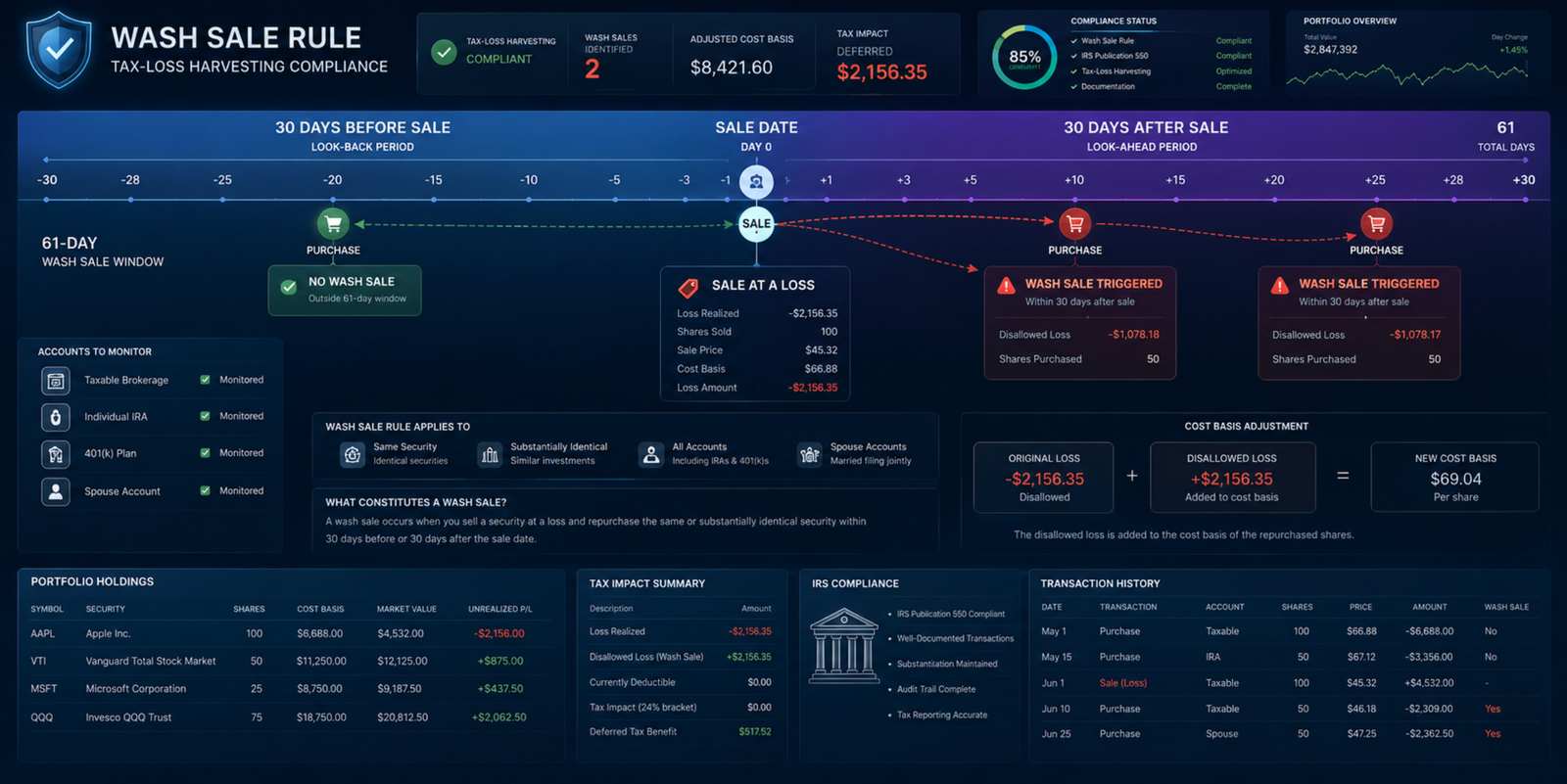 Understanding how tax-loss harvesting works is only half the equation. The wash sale rule may affect whether a realized loss is currently deductible, making it an important consideration when evaluating a tax-loss harvesting strategy.
The wash sale rule, found in IRC §1091, exists to prevent investors from claiming a tax loss while maintaining essentially the same investment position.
What Is the Wash Sale Rule?
A wash sale occurs when you sell a security at a loss and then acquire the same or a substantially identical security within a specific time frame.
The rule covers a 61-day window:
- The 30 days before the sale
- The day of the sale
- The 30 days after the sale
If a wash sale occurs, the IRS generally does not allow the loss as a current-year deduction.
The rule can also apply to purchases made during the 30 days before the sale, not only to purchases made after it.
What Does “Substantially Identical” Mean?
The phrase “substantially identical” creates much of the confusion surrounding tax loss harvesting rules.
The IRS has not provided an exhaustive definition that covers every investment scenario. However, the concept generally extends beyond buying back the exact same security.
For example, purchasing an investment that closely mirrors the one you sold may create risk, even if the ticker symbol is different. This becomes particularly relevant when investors attempt to replace one index-tracking investment with another that follows nearly identical holdings. Holding another investment in the same sector, by itself, does not necessarily make it substantially identical.
When replacing a sold position, investors may need to weigh continued market exposure against wash-sale considerations.
The Rule Extends Across Accounts
Another commonly overlooked issue is that the wash sale rule is not limited to a single brokerage account.
Transactions in taxable accounts, IRAs, 401(k)s, and accounts held by a spouse may need to be considered together when evaluating wash-sale considerations. An investor could sell a position for a loss in one account while unknowingly purchasing a substantially identical investment elsewhere.
This is one reason a review of transaction activity across relevant accounts can be important when implementing a harvesting strategy.
A Disallowed Loss Is Usually Deferred, Not Lost
When a wash sale occurs, the loss is generally not gone forever.
When the replacement security is acquired in a taxable account, the disallowed loss is typically added to the cost basis of the replacement security. This adjustment may allow the loss to be recognized later when the replacement investment is eventually sold. If a substantially identical replacement security is purchased in an IRA or Roth IRA, the loss is generally disallowed and is not added to the account’s basis.
However, the timing benefit is lost. For investors seeking current-year tax savings, that delay can limit the loss’s current-year tax relevance.
The Most Common Wash Sale Mistakes
Many wash sales happen accidentally.
One common mistake is selling an investment for a loss and buying it back a week later within the wash sale window. Another is purchasing a substantially identical investment inside a retirement account while attempting to harvest a loss in a taxable account.
A third common mistake involves switching between investments that track nearly identical indexes. While investors may believe they have changed investments, the IRS could view the positions differently than expected.
Example: How a Wash Sale Can Occur
Imagine you sell an investment on November 15 and realize a $5,000 loss.
If you purchase the same investment on November 25, just 10 days later, the transaction falls within the 30-day post-sale period. Under IRC §1091, the loss would generally be disallowed for current-year tax purposes.
The investor still owns the investment, but the loss may not be currently deductible.
Decision Takeaway
Tax-loss harvesting may have different tax consequences when the wash sale rule applies. Understanding IRC §1091 and considering purchase activity across relevant accounts may help clarify whether a realized loss may be currently deductible.
When Tax-Loss Harvesting Genuinely Helps
One reason tax-loss harvesting receives so much attention is that it may be used to offset taxable gains in certain circumstances. The key phrase is “under the right circumstances.” The potential tax effect is tied to specific situations rather than being universally available.
Generally speaking, tax-loss harvesting may be more relevant when you have taxable gains to offset, realized losses in a taxable account, and a longer-term planning context for any unused losses.
Investors With Significant Taxable Gains
Tax-loss harvesting is often most relevant during years when taxable gains are unusually high.
For example, you might rebalance a portfolio and sell appreciated investments. You might sell a business interest, liquidate a concentrated stock position, or dispose of inherited assets that have generated taxable gains. In these situations, harvested losses may be used to offset gains that would otherwise be subject to tax.
The current-year tax effect may differ when offsetting short-term gains. Because short-term gains are generally taxed at ordinary income tax rates, a loss used against those gains may have a different tax impact than a loss used against gains subject to long-term capital gains rates.
How Tax Rates May Affect Tax-Loss Harvesting
A $10,000 harvested loss may not have the same tax effect for every investor.
Someone in a higher tax bracket may experience a different tax effect because the loss offsets gains that would have been taxed at higher rates. Meanwhile, an investor in a lower bracket may experience a more modest current-year tax effect from the exact same loss.
This is one reason discussions about tax loss harvesting benefits should always include context. The tax treatment depends on how the loss interacts with your overall tax situation, not simply on the existence of a loss itself.
Market Volatility Can Create Opportunities
Periods of market volatility often create harvesting opportunities that would not exist in calmer markets.
An investment may decline temporarily while still fitting within your long-term strategy. In that situation, you may be able to realize a loss, consider a non-identical replacement investment in relation to your allocation and wash-sale considerations, and evaluate whether the transaction has tax relevance within your broader plan.
Tax-loss harvesting is a tax-aware planning consideration, not a market-timing strategy. The focus is not on predicting market movements. Instead, the discussion centers on whether a realized loss and any replacement investment align with your tax and portfolio considerations.
When Capital-Loss Carryforwards May Have Future Tax Relevance
Some tax-loss harvesting considerations extend beyond the current year.
Suppose an investor harvests losses during a difficult market year but has limited gains to offset immediately. Under IRC §1212, those unused losses may carry forward indefinitely.
Years later, those accumulated losses may help offset gains from rebalancing, investment sales, or other taxable events. In that scenario, the tax relevance of the harvesting decision may depend on future taxable gains, income, and applicable tax rules. For related context, see [How to Plan Tax-Efficient Retirement Withdrawals].
Tax-Loss Harvesting as Part of Long-Term Planning
Tax-loss harvesting is often considered within a larger planning process.
Investors who consistently monitor taxable accounts, coordinate gains and losses, and incorporate tax considerations into portfolio decisions may identify tax-related considerations throughout the year rather than relying only on year-end review.
That does not mean harvesting losses every time an investment declines. It means evaluating whether realizing a loss today could have tax relevance in a future year, based on individual circumstances and applicable rules.
Decision Takeaway
Tax-loss harvesting may be more relevant when realized losses can offset current or future taxable gains. Any potential tax effect depends on factors such as tax rates, account type, available carryforwards, and an individual’s broader planning considerations.
When Tax-Loss Harvesting Doesn’t Help
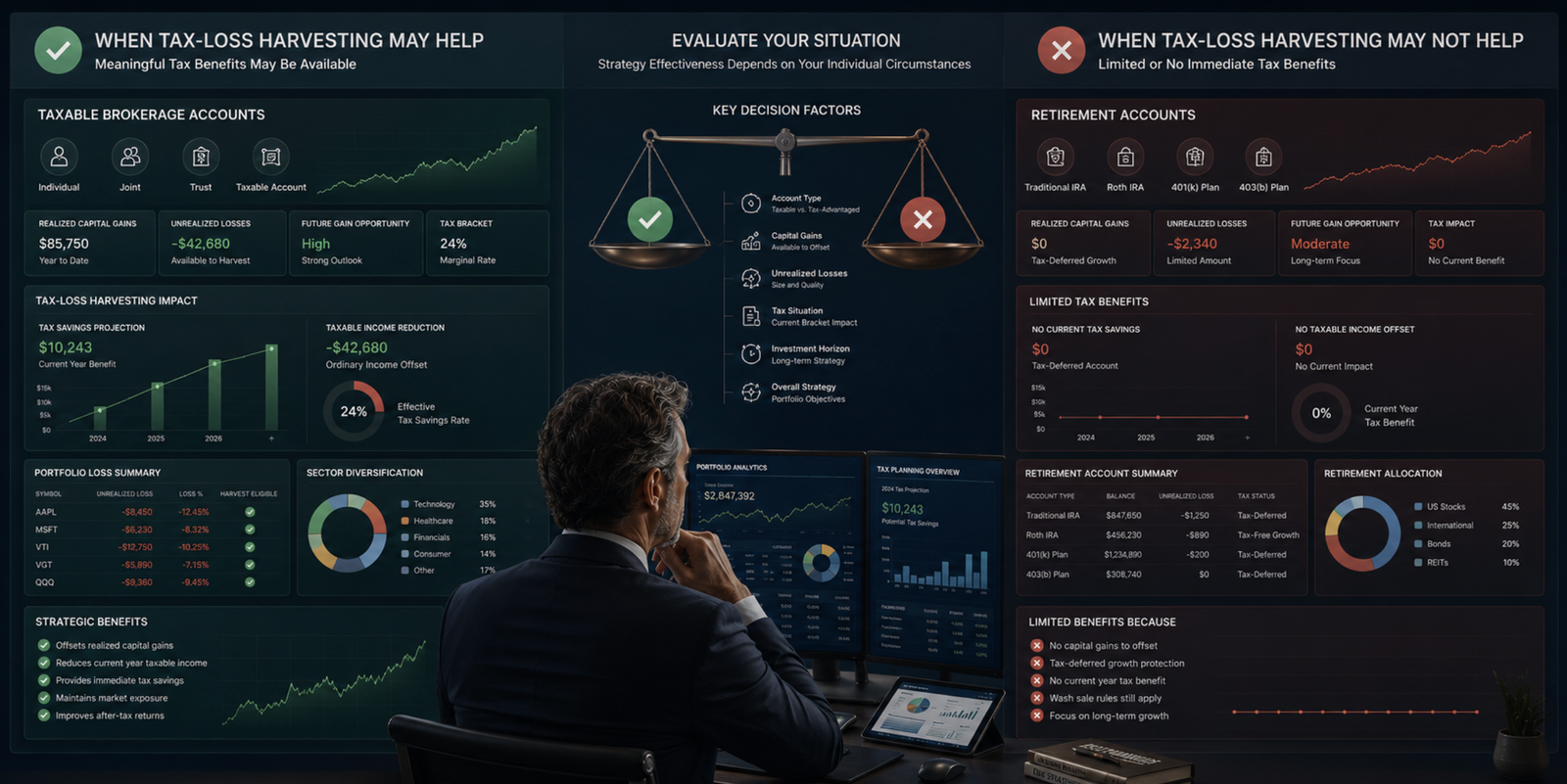
Many discussions about tax-loss harvesting focus on potential benefits while giving relatively little attention to its limitations.
In reality, there are situations where harvesting losses may provide little immediate tax relevance or no meaningful current-year federal tax effect. Understanding these situations is just as important as understanding when the strategy works.
Low-Bracket and 0% Capital Gains Years
One commonly overlooked limitation involves investors who fall into the 0% long-term capital gains bracket.
If long-term gains are already receiving favorable tax treatment, harvesting losses may not provide the same benefit that they would for someone paying a higher capital gains tax rate. When gains are subject to a 0% federal rate, there may be little or no current federal tax on those gains for losses to offset.
This does not necessarily mean harvesting losses is never appropriate. It simply means the expected benefit may be smaller than many investors assume.
Retirement Accounts and Tax-Deferred Accounts
Tax-loss harvesting does not apply to gains and losses inside retirement accounts.
Traditional IRAs, Roth IRAs, 401(k)s, and similar accounts generally do not recognize gains and losses for current-year tax purposes. Because of that structure, harvesting losses inside these accounts is not possible.
Investors who hold most of their assets within retirement plans may find that tax loss harvesting benefits are limited simply because they do not have sufficient assets in taxable accounts.
No Gains to Offset
Another common scenario involves investors with losses but few or no gains.
While net capital losses can offset up to $3,000 of ordinary income annually under IRC §1211, larger losses may take years to fully utilize if future gains remain limited.
For example, an investor with a $30,000 net capital loss and no meaningful capital gains may only use a small portion of that loss each year against ordinary income. The remaining balance can carry forward, but the immediate benefit may be relatively modest.
Small Losses and Limited Tax Savings
Not every unrealized loss may justify a harvesting transaction.
If a position has declined only slightly, the tax benefit may be outweighed by trading costs, bid-ask spreads, administrative complexity, or changes to the overall portfolio allocation.
This is one reason investors should think carefully about the concept of maximum tax loss harvesting. The question is not whether every available loss should be harvested, but whether a transaction has potential tax relevance after accounting for costs, portfolio considerations, and wash sale rules.
When Future Gains Are Unlikely
Tax-loss harvesting is often described as creating future flexibility through carryforwards.
However, when future taxable gains are limited, the value of those carryforwards may be less significant. While losses can remain available indefinitely under IRC §1212, the practical benefit depends on eventually having gains or income against which those losses can be applied.
Tax-Loss Harvesting May Help vs. May Not Help
| Tax-Loss Harvesting May Help | Tax-Loss Harvesting May Not Help |
|---|---|
| Taxable account with realized capital gains | 0% long-term capital gains bracket |
| Meaningful unrealized losses relative to transaction costs | Assets primarily in IRAs or 401(k)s |
| Significant realized gains | No taxable gains available to offset |
| Potential future taxable gains that could use carryforwards | Limited future tax exposure |
| Meaningful unrealized losses | Small losses with minimal benefit |
Decision Takeaway
Tax-loss harvesting may have limited current-year tax relevance when there are no taxable gains to offset, gains are subject to a 0% federal rate, or most assets are held in retirement accounts. Its potential tax effect depends on factors such as tax rates, account type, available losses, future taxable gains, transaction costs, and broader planning considerations.
What Investors Often Miss
Many articles explain the mechanics of tax-loss harvesting and the wash sale rule. Far fewer discuss the practical details that can affect the transaction’s tax treatment and its fit within a broader portfolio approach.
These implementation details can affect tax reporting, transaction costs, and portfolio considerations.
Cost Basis Tracking Matters
When investors think about harvesting losses, they often focus on market value rather than cost basis.
However, the gain or loss reported for tax purposes depends on the shares being sold and how those shares are identified. Depending on your accounting method, the tax result may differ from what you expect.
Specific identification methods may provide more flexibility than other approaches because they allow investors to choose particular tax lots when selling. Without careful tracking, an anticipated loss may be smaller than expected.
Similar Is Not Always Different Enough
Many investors understand they cannot immediately repurchase the same investment after harvesting a loss.
What receives less attention is the risk of purchasing something that appears different but may still be considered substantially identical for wash sale purposes.
This issue frequently arises when investors attempt to maintain nearly identical market exposure after a sale. While replacing an investment can be appropriate, the replacement should be evaluated carefully rather than selected automatically.
State Tax Rules May Differ
Federal tax treatment often receives most of the attention, but state tax rules can also influence the value of harvesting losses.
Some states do not fully conform to federal capital-loss treatment or carry-forward rules. As a result, the state-level tax treatment may differ from federal treatment.
Because state tax treatment varies by jurisdiction, investors should consider both federal and state tax treatment when assessing a transaction’s potential tax effect. For broader context on related planning considerations, see [Tax and Estate Planning Overview].
Transaction Costs and Portfolio Disruption
Tax considerations are only one part of the equation.
Trading costs, bid-ask spreads, and portfolio changes can affect the potential tax effect and practical relevance of a harvesting strategy. In smaller positions, the potential tax effect may be limited relative to the effort or disruption.
For example, harvesting a relatively small loss may have limited tax relevance while requiring multiple trades and portfolio adjustments. In that case, the practical benefit could be limited.
Tax Strategy Alone Is Not the Goal
One common concern is allowing tax considerations to outweigh broader investment objectives.
Tax considerations matter, but they should support the overall investment plan rather than replace it. A transaction that changes portfolio allocation or investment exposure in a way that is inconsistent with broader objectives may warrant closer review, even when it has potential tax relevance.
Tax harvesting discussions typically consider tax treatment alongside investment discipline and broader portfolio objectives.
Decision Takeaway
Execution details matter. Cost-basis methods, replacement investments, state tax treatment, and transaction costs can affect the tax treatment and portfolio implications of tax loss harvesting strategies.
How TLH Fits Into a Broader Financial Plan
Tax-loss harvesting is often discussed as a standalone tactic, but it may be considered alongside investment allocation, retirement planning, charitable giving, and long-term tax considerations.
When viewed in isolation, tax-loss harvesting can seem like a simple exercise in realizing losses for tax purposes. Within a broader plan, it is one consideration among several that may affect portfolio and tax decisions over time.
Asset Location Matters
One reason tax-loss harvesting receives so much attention is that it applies only to taxable accounts. That naturally raises a broader planning question: which investments belong in taxable accounts, and which belong in tax-deferred or tax-free accounts?
This concept, often called asset location, focuses on how investments are allocated across taxable, tax-deferred, and tax-free accounts, which may have different tax treatment. While tax-loss harvesting can only occur in taxable accounts, other tax and investment considerations may apply inside IRAs, Roth IRAs, and employer-sponsored retirement plans.
Understanding the role of each account type can help you consider tax-loss harvesting within the context of broader account and portfolio decisions.
Coordinating With Portfolio Rebalancing
Tax-loss harvesting can be considered alongside portfolio rebalancing.
Suppose a portion of your portfolio has declined significantly while other areas have performed well. Harvesting the loss may allow you to realize a loss for tax purposes while rebalancing in relation to your target allocation, subject to applicable tax rules and wash-sale considerations.
An investor may consider a non-identical replacement investment when maintaining market exposure, although whether a replacement is substantially identical for wash-sale purposes depends on the specific facts and circumstances. This approach can place tax considerations alongside allocation and diversification considerations rather than treating them separately.
Pairing TLH With Other Tax Strategies
Tax-loss harvesting is not the only planning consideration that may have tax relevance.
For example, donating appreciated securities to charity may have different tax consequences than selling them first, depending on applicable rules and individual circumstances. In the right circumstances, combining charitable giving with harvested losses may involve several tax and investment considerations within a given tax year.
Retirement planning can also influence harvesting decisions. Future income needs, anticipated Roth conversions, and withdrawal strategies may affect the timing and potential use of capital-loss carryforwards. For additional context, see [How to Plan Tax-Efficient Retirement Withdrawals] and [Tax and Estate Planning Overview].
Year-End Is Not the Only Opportunity
Many investors associate tax-loss harvesting with December because year-end tax planning receives significant attention.
However, market declines do not follow the calendar. Tax-loss-harvesting considerations may arise throughout the year, particularly during periods of increased volatility.
The calendar is one factor among several that may be considered when evaluating realized losses, portfolio allocation, transaction costs, wash-sale rules, and applicable tax considerations.
Decision Takeaway
Tax-loss harvesting may be considered within a broader financial plan. Asset location, portfolio rebalancing, charitable giving, and retirement planning can each influence their tax treatment and relationship to broader portfolio considerations.
Working With a Fiduciary Advisor on Tax-Loss Harvesting
One challenge with tax-loss harvesting is that the same strategy can have different tax effects for different investors.
A harvested loss that may have meaningful tax relevance for one household may provide limited relevance for another. That is why tax-loss harvesting decisions should be evaluated within the context of your full financial picture rather than viewed in isolation.
Looking Beyond the Current Year
A fiduciary advisor’s role is not simply to identify potential tax deductions. It is to help frame how a transaction may relate to your broader planning considerations.
That analysis may include your current tax bracket, expected future income, retirement timeline, charitable goals, estate planning objectives, and state of residence. A recommendation that makes sense this year may not have the same relevance when viewed over a five- or ten-year horizon.
Liberty One Wealth is fee-only and does not receive commissions for trading activity. Tax-loss-harvesting discussions can therefore focus on how the transaction may relate to your planning considerations, rather than on trade-based compensation.
The Same Loss Can Produce Different Outcomes
Consider two investors who each incur a $20,000 loss.
The first investor is in a high-income year, has significant realized gains, and expects future taxable events. In that situation, the harvested loss may be available to offset current or future taxable gains, subject to applicable rules.
The second investor has limited gains, falls within a lower tax bracket, and holds most assets inside retirement accounts. While the loss may still have some value, the practical benefit could be considerably smaller.
The difference is not the amount of the loss. The difference is how the loss interacts with the investor’s broader circumstances.
Planning Before Acting
Tax-loss harvesting may warrant consideration before a transaction occurs rather than only after an investment declines.
Before selling an investment, it can be helpful to understand how the transaction may affect your taxes, portfolio allocation, future investment options, and long-term planning goals. Taking that broader view may help identify potential tradeoffs between a current tax consideration and future portfolio decisions.
Investors managing larger taxable portfolios may also want to explore [Direct Indexing and Tax-Loss Harvesting at Scale] for additional context on direct indexing and ongoing tax-loss-harvesting considerations. To discuss how tax-loss harvesting may relate to your broader planning considerations, [Schedule a Complimentary Planning Conversation].
Decision Takeaway
The relevance of a tax-loss-harvesting strategy depends on your broader financial picture, not simply the presence of an investment loss. A strategy that may have tax relevance for one investor may have limited relevance for another.
Frequently Asked Questions
What is the wash sale rule and how does it affect tax-loss harvesting?
The wash sale rule, found in IRC §1091, generally disallows a capital loss when you acquire the same or a substantially identical security during the 61-day period beginning 30 days before the sale and ending 30 days after it. When the replacement security is acquired in a taxable account, the disallowed loss is generally added to its cost basis rather than allowed in the current year. A substantially identical purchase in an IRA or Roth IRA may result in the loss being disallowed without a corresponding basis adjustment.
Can I use tax-loss harvesting in my IRA or 401(k)?
Generally, no. Tax-loss harvesting applies only to taxable brokerage accounts because gains and losses inside IRAs and 401(k)s do not create current-year tax consequences. If all of your investments are held in tax-deferred or tax-free accounts, this strategy generally does not apply to those accounts.
How much can I deduct from ordinary income using capital losses?
Under IRC §1211, noncorporate taxpayers may generally use net capital losses to offset up to $3,000 of ordinary income per year, or $1,500 if married filing separately. If your losses exceed those limits, the remaining amount is not lost. Instead, it can generally be carried forward under IRC §1212 for use in future tax years, subject to applicable rules.
Do capital losses carry forward if I cannot use them this year?
Yes. IRC §1212 generally allows unused capital losses to carry forward indefinitely. Those losses may be available in future years to offset capital gains and, if losses remain, up to $3,000 of ordinary income annually. This is one reason tax-loss harvesting may still have future tax relevance even when the immediate tax benefit is limited.
What is the difference between harvesting short-term versus long-term losses?
Short-term losses are generally netted against short-term gains first, while long-term losses are generally netted against long-term gains first. Because short-term capital gains are generally taxed at ordinary income tax rates, a loss used to offset them may have a different tax effect than a loss used to offset long-term capital gains. The actual tax effect depends on your overall tax situation and the types of gains you have realized.
When does tax-loss harvesting not make sense for my situation?
Tax-loss harvesting may have limited current-year tax relevance if you are in the 0% long-term capital gains bracket, have no meaningful gains to offset, or hold assets primarily in IRAs and 401(k)s. It may also be less relevant if the losses are small relative to transaction costs or if future taxable gains may be limited, reducing the potential use of capital-loss carryforwards. The potential tax effect depends on your tax bracket, account structure, available gains and losses, and broader planning considerations.
Final Thoughts
Tax-loss harvesting may have tax relevance, depending on your tax situation, account structure, and long-term planning considerations. Understanding when it may apply, and when it may not, can provide context for evaluating it within a broader financial plan.
At Liberty One Wealth, tax-loss-harvesting discussions are considered within a broader financial planning framework, including account structure, portfolio considerations, and applicable tax rules. For a planning conversation about how tax-loss harvesting may relate to your circumstances, [Schedule a Complimentary Planning Conversation].