Introduction

Imagine you’re a high-income professional with a growing taxable investment account, company stock from RSUs, and concerns about how taxes may affect your long-term wealth. ETFs have served you well, but you may be wondering whether a more customized approach could offer additional flexibility.
When evaluating direct indexing vs ETFs, the key question is not which strategy is universally better, but which one may align with your tax situation, portfolio structure, and financial goals. This article explains the difference between direct indexing and ETFs, compares their tax efficiency, and explores which investors may find each approach relevant based on their circumstances.
This article is for informational and educational purposes only and is not investment, tax, or legal advice. Liberty One Wealth Advisors, LLC is an SEC-registered investment advisor. Please consult a qualified professional regarding your specific circumstances.
What Is Direct Indexing?
Direct indexing is an investment strategy in which an investor directly owns the individual securities that make up an index through a separately managed account (SMA). Instead of purchasing a fund that tracks an index, you own the underlying stocks themselves.
Modern portfolio technology may help these accounts seek to track the performance of a target index while allowing individual securities to be managed separately. This may allow for tax-lot management and customization that are not typically available through pooled investment vehicles.
One of the most significant features of direct ownership is tax-lot control. Because each stock is held individually, gains and losses can be managed at the security level rather than at the portfolio level.
Historically, direct indexing was primarily available to institutional investors and ultra-high-net-worth households. As technology has improved, minimum account requirements have declined. Even so, direct indexing is generally most appropriate for investors with substantial taxable assets for whom its added complexity, costs, and potential tax-lot management may warrant consideration.
When people ask, “How does direct indexing differ from ETFs?” The answer begins with ownership. Direct indexing provides ownership of the individual holdings themselves, creating flexibility that may support more personalized planning.
What ETFs Offer

An exchange-traded fund (ETF) is a pooled investment vehicle that tracks an index or investment strategy and trades on a public exchange. Instead of owning the underlying stocks directly, investors own shares of the fund.
ETFs have become popular because they can offer broad diversification, low costs, liquidity, and simplicity. Investors can often gain exposure to hundreds or thousands of securities through a single purchase.
Another advantage is accessibility. ETFs can typically be purchased regardless of account size, making them useful for investors at virtually every stage of wealth accumulation.
ETFs can also be highly tax-efficient in taxable accounts. Through an in-kind creation and redemption process, many ETFs may limit capital gains distributions to shareholders. This feature can make ETFs a practical option for many taxable investors.
However, investors do not control the individual securities held inside the fund. While an ETF position itself may be sold at a loss, losses cannot generally be harvested from specific holdings within the fund.
This ownership distinction is one of the most important differences between ETF and direct indexing strategies.
Direct Indexing vs ETFs Comparison at a Glance
| Feature | Direct Indexing | ETFs |
|---|---|---|
| Ownership | Individual securities | Pooled fund |
| Tax-Loss Harvesting | Individual-stock level | Fund position level |
| Customization | High | Limited |
| Account Minimums | Often $250,000–$500,000+ | Minimal |
| Fees | Generally higher | Generally lower |
| Diversification | Broad but customizable | Broad and standardized |
| Tracking Error | Possible | Typically limited |
| Best Use Case | Large taxable accounts | Many investors and account types |
While this direct indexing vs ETFs comparison highlights key differences, tax considerations may be an important factor when evaluating which strategy fits your circumstances.
The Tax-Aware Comparison: Cost Basis, Harvesting, and Capital Gains
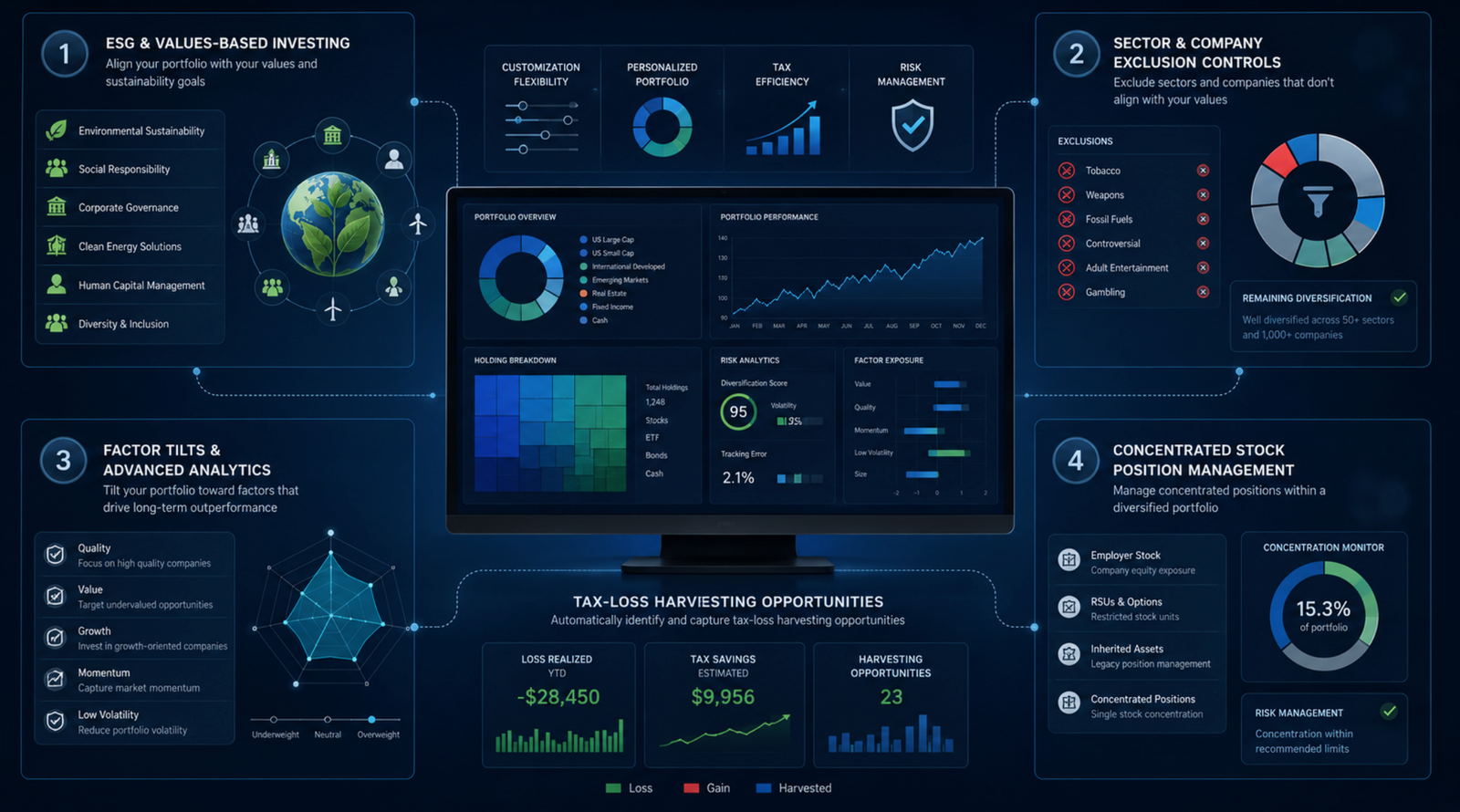
For many high-income investors, tax management is one reason to consider direct indexing. The ability to manage individual securities creates opportunities that may not exist within a traditional ETF structure.
Tax-Loss Harvesting Flexibility
Tax-loss harvesting involves selling investments that have declined in value to realize losses that may offset taxable gains.
With direct indexing, losses may be harvested at the individual stock level. Even when the overall portfolio is positive, some holdings may have declined enough to create harvesting opportunities.
For example, an index-tracking portfolio may contain dozens or hundreds of stocks. If several positions decline while the broader market remains positive, those individual losses may be harvested while maintaining similar market exposure through replacement securities.
With ETFs, investors generally sell shares of the ETF position to realize a loss. They generally cannot harvest losses from the individual holdings within the fund.
These potential tax considerations are central to discussions of direct indexing tax benefits vs ETFs. For additional context, see [Tax-loss harvesting strategies for investors].
Investors should also be aware of the IRS wash-sale rules under IRC §1091. These rules may disallow losses if substantially identical securities are repurchased within the required timeframe. Because tax rules can be complex, this may warrant coordination with a qualified tax advisor.
Cost Basis and Capital Gains Control
Another feature of direct ownership is greater control over cost basis management.
When securities are owned individually, investors may choose which tax lots to sell. This flexibility may allow gains and losses to be managed more intentionally over time.
For example, an investor who needs to raise cash may choose higher-cost shares first, which may affect the gains recognized. Alternatively, they may strategically realize gains as part of a broader tax plan.
ETF investors generally do not have the same level of control because they own shares of a pooled vehicle rather than the underlying holdings.
This direct indexing vs ETFs tax efficiency comparison often becomes increasingly relevant as taxable account balances grow.
Customization Advantages: Factor Tilts, ESG, and Exclusion Lists
Customization is another area where direct indexing may provide advantages for certain investors.
While ETFs offer broad diversification, they generally follow a predefined investment methodology. Direct indexing may allow portfolios to be tailored more closely to an investor’s circumstances and preferences.
Values-Based and Sector Exclusions
Some investors prefer to exclude specific industries or companies from their portfolios. Others may want investments that better reflect environmental, social, governance, faith-based, or personal values.
Direct indexing may allow these exclusions to be incorporated while seeking to maintain broad market exposure, although exclusions can create tracking differences from the underlying index.
This level of customization may be particularly appealing to investors who feel traditional index funds do not fully align with their priorities.
Factor Tilts and Portfolio Preferences
Direct indexing can also support factor-based adjustments.
For example, investors may choose to emphasize quality, value, or other characteristics within a portfolio. While factor-focused ETFs exist, direct indexing can provide additional flexibility when implementing these preferences.
As with any investment decision, these adjustments should be evaluated within the context of an overall financial plan rather than in isolation.
Managing Concentrated Stock Positions
Many high-income professionals accumulate concentrated positions through employer stock programs, RSUs, stock options, or inheritance.
In these situations, diversification can become challenging because selling large positions may create significant taxable gains.
Direct indexing may help investors exclude a concentrated holding from an index-replication portfolio, which may allow diversification decisions to be evaluated without requiring an immediate sale of the concentrated stock.
For families with substantial appreciated assets, this flexibility can become an important part of long-term planning.
Where ETFs Still Win
A balanced direct indexing vs ETFs comparison must acknowledge that ETFs may be a practical choice for many investors.
In fact, for numerous situations, ETFs may be the more practical and cost-effective choice.
Simplicity and Accessibility
ETFs are easy to understand, easy to purchase, and easy to maintain.
Investors can build diversified portfolios with relatively few holdings and minimal operational complexity. This simplicity is one reason ETFs continue to play a central role in many investment plans.
Lower Costs and Lower Minimums
Cost is another important consideration.
Direct indexing management fees are generally higher than passive ETF expense ratios. Investors should evaluate whether potential tax-related benefits, if realized, may justify the additional costs.
Account size also matters. Direct indexing programs often require approximately $250,000 to $500,000 or more before the strategy may warrant consideration. ETFs, by contrast, can be implemented with virtually any investment amount.
For investors still building wealth, the lower cost and accessibility of ETFs may make them a more appropriate choice.
Why ETFs Often Make Sense in Retirement Accounts
Tax-loss harvesting is one of the primary advantages of direct indexing. However, that advantage generally does not apply in the same way inside tax-deferred retirement accounts.
Because gains and losses are not typically recognized in the same way within IRAs and 401(k)s, the tax-management benefits of direct indexing become less meaningful.
In these accounts, ETFs often provide a simpler and lower-cost solution. For additional context on placing investments across taxable and tax-deferred accounts, see [How asset location can reduce your tax burden].
When Direct Indexing Fits a High-Income Investor
Direct indexing is not necessarily better than ETFs. Its value depends on the investor’s specific circumstances.
Several situations may make direct indexing worthy of consideration.
Large Taxable Accounts
Larger taxable accounts may create more opportunities for tax-loss harvesting.
As portfolios grow beyond approximately $250,000, investors may have enough individual positions and tax exposure for the strategy’s benefits to become more meaningful.
A larger taxable portfolio may create additional opportunities to evaluate tax-loss harvesting and tax-lot management, depending on the investor’s holdings, realized gains, and overall circumstances.
High Marginal Tax Brackets
Investors in higher federal and state tax brackets often pay closer attention to tax efficiency.
Harvested losses may offset gains that would otherwise be taxed at long-term or short-term capital gains rates. While outcomes vary, higher tax rates can increase the potential value of tax-management strategies depending on the investor’s gains, losses, and applicable tax rules.
Concentrated Stock Exposure
Executives, business owners, and long-term employees frequently accumulate concentrated stock positions.
Whether the concentration comes from RSUs, employer stock, or inherited assets, direct indexing may help support gradual diversification while allowing tax considerations to be evaluated as part of the broader plan.
Charitable Giving Strategies
Charitable planning can also create opportunities.
Investors who donate appreciated securities to donor-advised funds or charitable organizations may benefit from having access to individual tax lots.
Being able to select specific appreciated holdings for donation may affect tax and charitable-planning considerations while supporting charitable goals.
Investors Seeking Customization
Some investors simply want more control over how their portfolios are constructed.
Whether that means excluding specific companies, incorporating values-based preferences, or adjusting portfolio exposures, direct indexing may provide flexibility that standard ETF structures may not offer to the same degree.
Implementation Considerations and Fees
Before using direct indexing, investors may want to understand the operational requirements and trade-offs involved.
Separately Managed Account Structure
Direct indexing is typically implemented through a separately managed account held with a custodian.
The portfolio is managed according to a defined investment strategy while maintaining ownership of individual securities.
The SEC provides guidance regarding separately managed accounts, and investors may want to understand how these arrangements operate before entering into one.
Fees and Potential Benefits
Direct indexing generally carries higher management costs than passive ETF investing.
Whether those additional costs may be warranted depends on the tax results actually realized, applicable fees, and the investor’s specific objectives.
The relationship between potential tax-related benefits and added costs may vary by situation.
Tracking Error and Portfolio Drift
Direct indexing portfolios may not perfectly match their benchmark index.
Tax-loss harvesting activity, exclusions, and customization choices can all contribute to tracking error. As a result, performance may deviate from the target index over time.
This is not necessarily a problem, but it is an important trade-off to understand.
Coordination With Tax Professionals
Tax strategies should not be evaluated in isolation.
A harvesting opportunity that appears attractive on its own may have broader implications when viewed alongside [Retirement withdrawal planning and tax strategy], charitable giving, estate planning, and future tax obligations.
Coordinating investment decisions with a qualified tax advisor may help evaluate portfolio strategies alongside broader financial goals.
Is Direct Indexing Right for Your Plan?
The decision between direct indexing and ETFs should be driven by your overall financial plan, not by investment trends or product marketing.
For some investors, a large taxable portfolio, a high tax bracket, concentrated stock exposure, or charitable planning goals may make direct indexing worth considering. For others, the simplicity and lower costs of ETFs may remain the more appropriate fit.
In many cases, the answer is not direct indexing or ETFs; it is both. A well-designed strategy may use ETFs in retirement accounts while reserving direct indexing for taxable assets where individual-security ownership may support tax-lot management.
Liberty One Wealth considers investment decisions within the context of broader financial goals, portfolio structure, and tax considerations. If you would like an objective perspective on your portfolio and related planning considerations, [Talk to a fiduciary advisor about your portfolio] to discuss what may be relevant to your circumstances.
Frequently Asked Questions
What is the main difference between direct indexing and ETFs?
The primary difference between direct indexing and ETFs is ownership. With direct indexing, you own the individual stocks that make up an index through a separately managed account. With an ETF, you own shares of a pooled fund that holds those investments on your behalf.
How does tax-loss harvesting work differently in direct indexing vs. an ETF?
Direct indexing may allow losses to be harvested at the individual-security level, potentially while maintaining similar market exposure through replacement securities, subject to applicable tax rules. ETF investors generally must sell shares of the ETF position to realize a loss and cannot generally harvest losses from individual holdings within the fund. This difference may provide more tax-lot management flexibility in taxable accounts.
What account minimum is typically required to use direct indexing?
Requirements vary by provider, but direct indexing is often most practical for taxable portfolios of approximately $250,000 to $500,000 or more. Larger accounts may create additional opportunities to evaluate tax-loss harvesting and customization.
Is direct indexing worth the higher fees for high-income investors?
It depends on the investor’s circumstances. Tax bracket, portfolio size, concentrated holdings, customization needs, applicable fees, and tax results actually realized all influence whether the additional costs may warrant consideration.
Can direct indexing help manage a concentrated stock position?
It may. Investors with employer stock, RSUs, or inherited positions may use direct indexing to exclude a concentrated holding from an index-replication portfolio while evaluating gradual diversification and related tax considerations.
Should I use direct indexing in a retirement account like an IRA?
For many investors, direct indexing may be less relevant inside tax-deferred accounts because tax-loss harvesting generally does not provide the same planning benefit. ETFs may be a simpler, lower-cost option in IRAs and 401(k)s, depending on investment objectives and desired customization.